Items that can be Passed on -Domestic/Expo and Exposition Materials COLLECTION-
2020/08/20- share
-


- text and edit by
- Atsuko Ishikawa
Ever since I was assigned to the information and reference room in Osaka as a librarian, I have been working to organize materials with the aim of making the room useful. I would like to introduce NOMURA Co., Ltd., the Expo, and the Expo COLLECTION from the perspective of having been involved in "things that cannot be left without awareness" for many years.
1. NOMURA Co., Ltd., Ltd. and the Expo
Founded in 1892 (Meiji 25), the company entered the Taisho era, when the founder, Taisuke Nomura, staged chrysanthemum dolls, which were popular as entertainment for the masses at the time, with large-scale devices and devices, and created the "Chrysanthemum doll Nomura". It is now called.
On the other hand, at the Tokyo Taisho Exposition held in 1914 (Taisho 3), we exhibited the “Nama Ningyokan,” a spectacle using almost life-size dolls made to look as if they were alive.

1914 Tokyo Taisho Exposition Illuminations

Tairei Commemorative Kyoto Exposition_Nama Dolls
Since then, we have been creating venues for events called expositions held at Kokugikan and department stores. In 1928 (Showa 3), the year of the exposition boom, we worked on pavilion exhibitions for the National Industrial Exposition held in Takamatsu, the birthplace of our company, and the Tairei Commemorative Domestic Promotion Tokyo Exposition held in Ueno Park.
.jpg)
1928 National Industrial Exposition (Takamatsu)
While being involved in numerous domestic expositions, after the war, in 1950 (Showa 25), we dispatched our employees overseas to the "Pakistan-Karachi International Trade Expo" as an exhibition engineer. ”, ”Tourist Japan”, Osaka City, Kanagawa Prefecture, Takashimaya, etc.

1951 Seattle Japan Trade Fair
On the other hand, our involvement with international expositions began with the construction of the Japan Pavilion at the 1964 New York World Exposition, which was held without approval from the Bureau International des Expositions (BIE).
At the Japan World Exposition (Osaka Expo), which was the first international exposition in Asia, I was involved in the construction of 18 pavilions. Expo 2005 Osaka was a major turning point for our company, as we experienced (1) joint ventures (JV), (2) technological development of robots, etc., and (3) contracts with overseas display companies.
After that, he was involved in the construction of 13 exhibitions at the 1975 Okinawa Ocean Expo, 22 exhibitions at the 1985 International Science and Technology Exposition (Tsukuba Expo), and 24 exhibitions at the 2005 Japan International Exposition (Aichi Expo). I was.
In addition, the exhibition construction of the Japan Pavilion at international expositions held overseas includes the 1992 Seville Expo and the Genoa Expo, the 1993 Daejeon Expo, the 1998 Lisbon Expo, the 2000 Hanover Expo, the 2010 Shanghai Expo, and the 2015 Milan Expo. it is continuing.
Currently, 200 hits for expositions in which our company has been involved in the construction of exhibitions are found in the database of the exposition materials COLLECTION, which will be described later. In the history of the Expo, which will celebrate its 130th anniversary in 2022, the exposition is greatly positioned as a footprint full of originality and ingenuity of our predecessors.
2. The Beginning of the Exposition Materials COLLECTION
For a long time, I had been working on creating a database of books and completion photos in order to respond to references from employees. “Mr. Tsuyoshi Terashita, who I used to visit once a week as an outside brain with Mr. Hashizume, is one of Japan’s leading exposition materials holders, and is looking for a recipient to donate to. If you have time, please let me see the materials."
As we approached the 21st century, we began to think about “having original content” in order to improve the reference room. The commercial facilities, PR/event facilities, public workspaces, cultural facilities, and leisure facilities in which our company is involved can be positioned in the vein of water that originates from expositions. We came to the conclusion that the expo materials were suitable as original content for our company. My boss and I went to see Mr. Terashita's exposition materials, and with the approval of the executives, we asked for donations.
In the fall of 2001, Mr. Terashita donated about 10,000 materials related to the Expo to our company under the sole condition that they should be useful to the world without being kept privately.

2001 When materials were brought in
The exhibition materials, which are said to be "in my head," were brought twice by 2-ton truck to the conference room, and the materials were organized under the motto of "not throwing away anything." From the beginning, we registered the database and classified and stored the source materials with a view to "publishing them outside the company".
Around this time, I was most afraid of being asked by Mr. Terashita, who came to the company once a week to learn about the materials, "Where are Mr. Ishikawa's materials?"
In June 2002, a meeting was held at the multi-purpose hall of the Osaka Office to showcase the materials donated by Mr. Terashita.
At that venue, the Expo Cultural History Study Group was launched at the suggestion of Professor Shinya Hashizume (currently Distinguished Professor at Osaka Prefecture University).
.jpg)
2002 Currently sorting out materials (Mr. Terashita is in the middle)
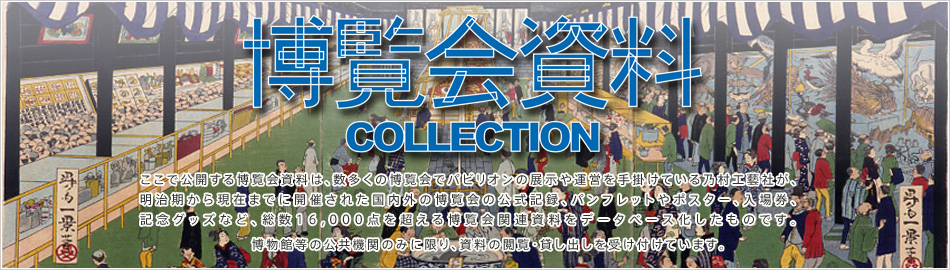
In 2005, when the Aichi Expo was held, as a result of the 20th exposition cultural history study group, Shinya Hashizume supervised "Separate volume Taiyou Nihon no exposition" (Heibonsha, February 2005) was published and a database was published. "Expo Materials COLLECTION" has been released on our website. (Currently, if you search for "exposition materials" on Google, it will be displayed on the top page. Click here for a brief history of the exposition / Click here for the exposition materials search)
1.jpg)
"Separate Volume Solar Japan Expo"
The public exhibition materials COLLECTION is not limited to public publications such as official records, photo collections, and posters, but is characterized by the fact that it covers miscellaneous materials such as nishiki-e, badges, medals, admission tickets, pamphlets, and postcards. I have.
In addition, from the Meiji period to the present day, it is a group of materials close to the comprehensive history of expositions held in Japan, covering almost all expositions held in Japan.
3. Expo Materials COLLECTION Spreading Outside the Company
After the materials have been released in publications and on the Internet, my work consists of donating materials from people who agree with the purpose, responding to inquiries from researchers, curators, and company personnel, viewing materials, and lending them. And so on, it spread from inside the company to outside the company. In 2011, I obtained a curator's qualification so as not to be embarrassed as someone who handles valuable materials.
Mr. Genpei Akasegawa, an actress from the Takarazuka Revue, who came to cover the program, Mr. Hiroshi Aramata and Mr. Taichi Sakaiya, who came to research materials for his book, and professors from Humboldt University, University of Pennsylvania, University of Manchester, Seoul University, etc. I was able to spend several hours or even days with people I rarely see.
In 2011, I began participating in a study group entitled "The World Exposition and Human History" led by Professor Mayuko Sano (currently a professor at the Kyoto University Graduate School). The study group was attended not only by global researchers in various specialized fields, but also by several expo practitioners.
After two years, Professor Sano began to talk about publishing a collection of papers as a result of the study group, saying, "I am not a researcher, so I cannot write a paper. There is no such thing.” "Even if you're not a researcher, if you have a work experience like Mr. Ishikawa's, there must be something you want to pass on to your juniors. Why don't you write it down?"
On my days off, I would go to the National Diet Library or the Tokyo Metropolitan Central Library, or look at my company's materials. With the help of seniors in the industry, I was finally able to submit my manuscript, "History of Lankaiya and the Decoration Industry Seen from Documents." (Listed in Mayuko Sano ed., World Expo and Human History (Shibunkaku Publishing, October 2015))

World's Fair and Human History Cover
In 2016, Professor Mayuko Sano convened the 2nd phase of the research group on "World Expositions and Human History". (1) I will be over 60 years old after 3 years of the period, and (2) Writing the thesis was hard work, so I was very worried about continuing.
However, I accepted the convocation because I wanted to “use the materials of the exposition without privately storing them, and to pass on the valuable experiences and wonderful encounters I gained through this study group to the next generation.”
In July 2020, Mayuko Sano edited "Expo Studies: A Method for Grasping the World of World Expositions" was published by Shibunkaku Publishing.

"Expo Studies: How to Grasp the World of Expo"
As in the previous collection, this collection contains 32 papers written not only by researchers but also exposition practitioners. From our company, Akihiko Shigyo, Seiichiro Mori, and Kyohei Kishida wrote a visual chronology "Changes in 'exhibition design' seen at the Japan Pavilion at the World Expo," and OB Akira Shimizu wrote a column "Flight to the Osaka World Exposition." Contributed the sequel "From the exhibition decoration industry to the display industry - development from before and after the Osaka Expo".
The expo materials collection is still growing, and at the same time, the human network continues to expand. The materials will also be published in "History of Social Studies Junior High School Students: History of Japan and History of the World" (Teikoku Shoin) from next year. I think this pandemic will greatly advance digitalization. Even more so, I am working today with the desire to pass the baton on to the 2025 EXPO beyond the “attractiveness of the original materials.”
Like this article?
- editor
-
-
EXPO MATERIALS COLLECTION
With a strong mind and a supple heart