Collect, preserve, open - how did the tactile participatory design system for the Osaka-Kansai Expo come about?
2025/12/26- share
-


- text and edit by
- Jiro Takano
The Osaka-Kansai Expo Design Exhibition was held at the Osaka Prefectural Enokojima Cultural Arts Creation Center (enoco) from October 1st to 19th. This article introduces the discussion that took place on October 11th during the talk program "See you again, Expo - What legacy will the Expo leave for society?"
After the Osaka-Kansai Expo opened, fan-created derivative works spread via social media, dramatically changing the atmosphere surrounding the event. A design system that allows anyone to get involved was built on the premise of this "participation." This talk featured Kota Hikiji, the creative director responsible for designing the design system, and Atsuko Ishikawa of NOMURA Co., Ltd. Expo Gallery, which houses over 20,000 items from past Expos. They discussed their perspective of viewing Expos not as "complete exhibition events" but as "places that are continually recorded and updated."
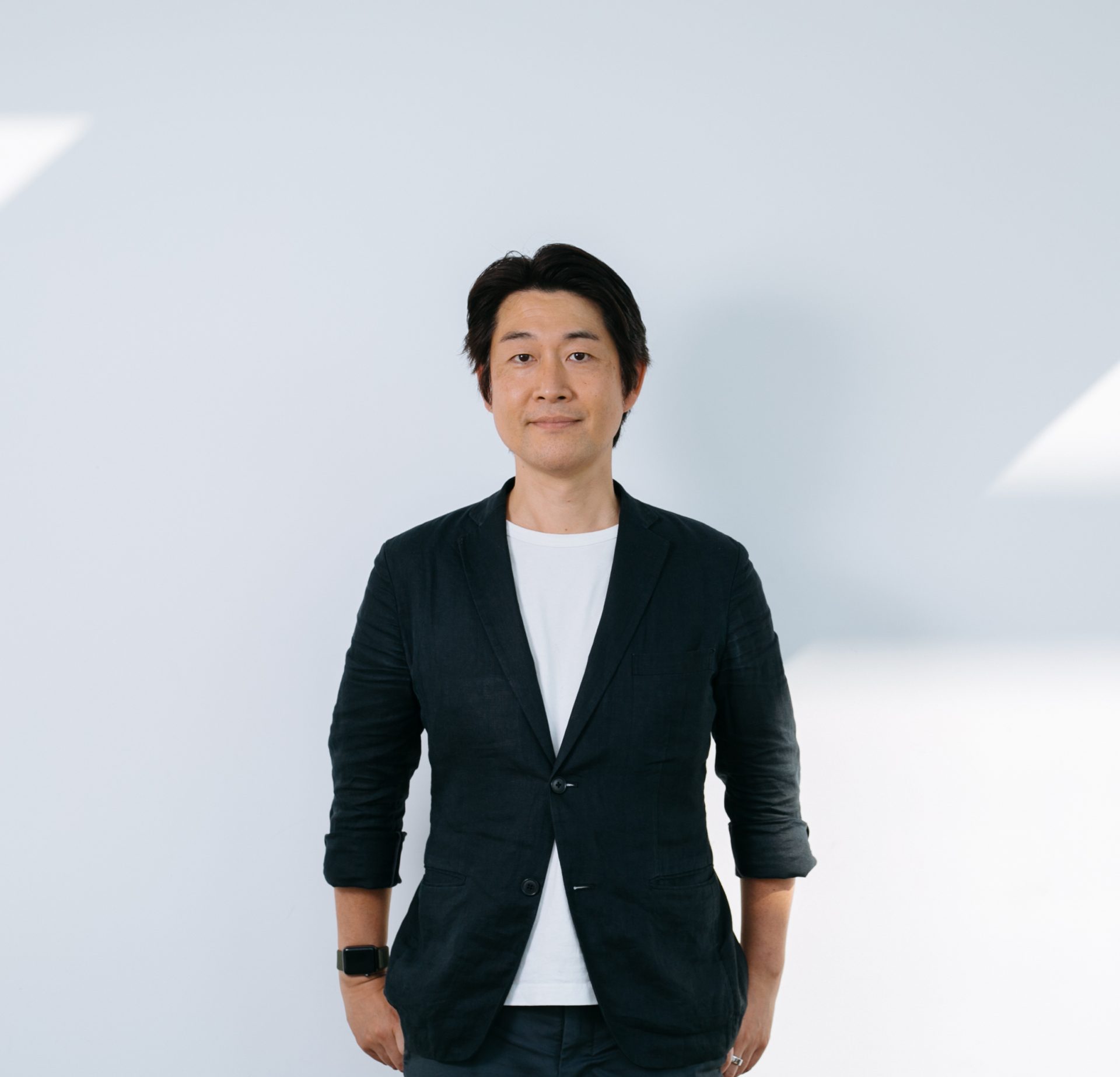
Mr. Kota Hikiji(hereinafter referred to as "Hikiji")
Hello everyone. My name is Hikiji Kota. I was in charge of the "design system" for Expo 2025 Osaka, Kansai, in other words, the overall branding. Thank you for coming today, even though it's a Saturday. This time, I've invited Atsuko Ishikawa from NOMURA Co., Ltd. to explore the history of Expos and think together about "what legacy Expos have left to society." The title of the talk is "See you, Expo 2025 - What legacy will Expos leave to society?" With just two days until the end of the exciting Expo 2025 Osaka, Kansai, Japan, this is a topic that is especially timely right now.
Atsuko Ishikawa (hereinafter referred to as "Ishikawa")
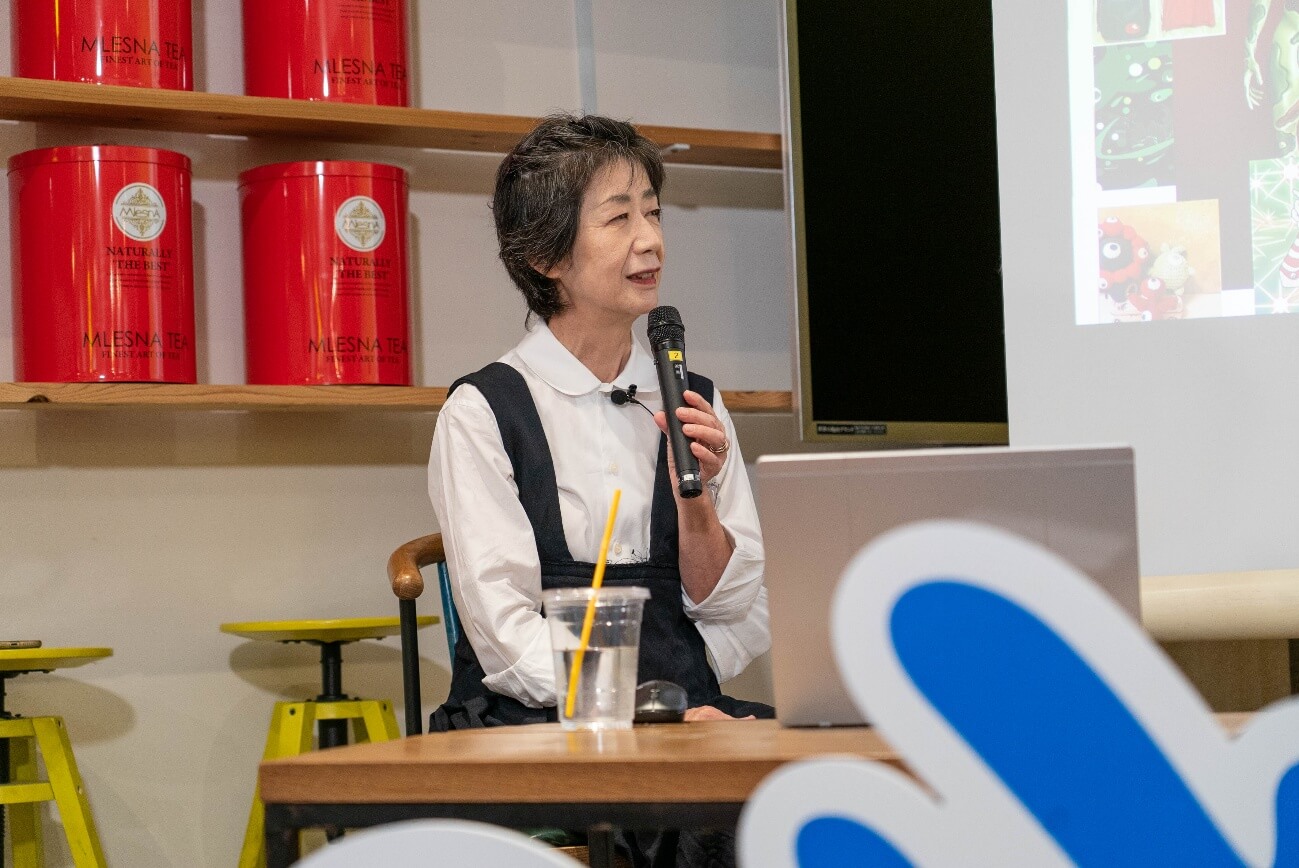
My name is Ishikawa. Nice to meet you. I am in charge of the Expo Archives at NOMURA Co., Ltd. We have a collection of over 20,000 items from the NOMURA Co., Ltd., and I am responsible for their safekeeping and management. The gallery has two functions: a storage and archives room and an exhibition room.
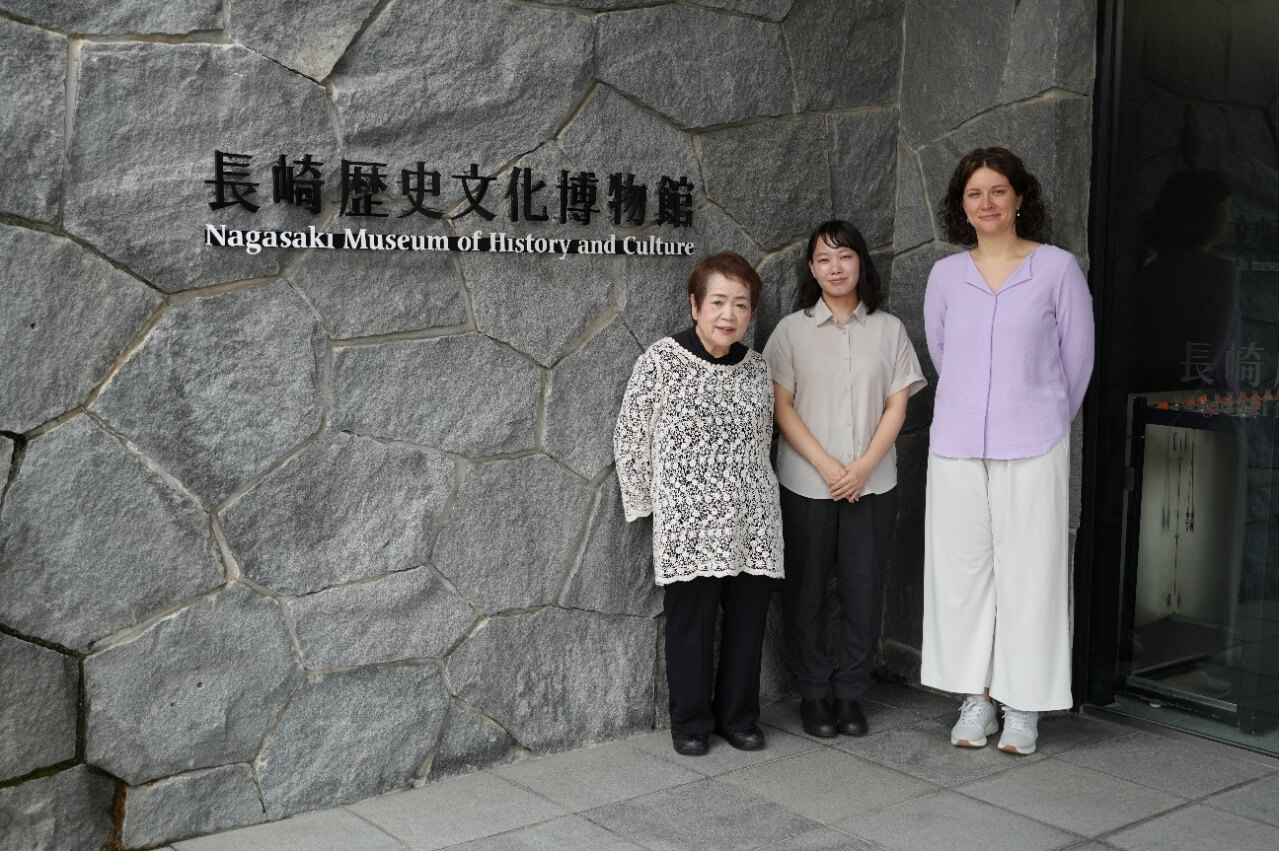
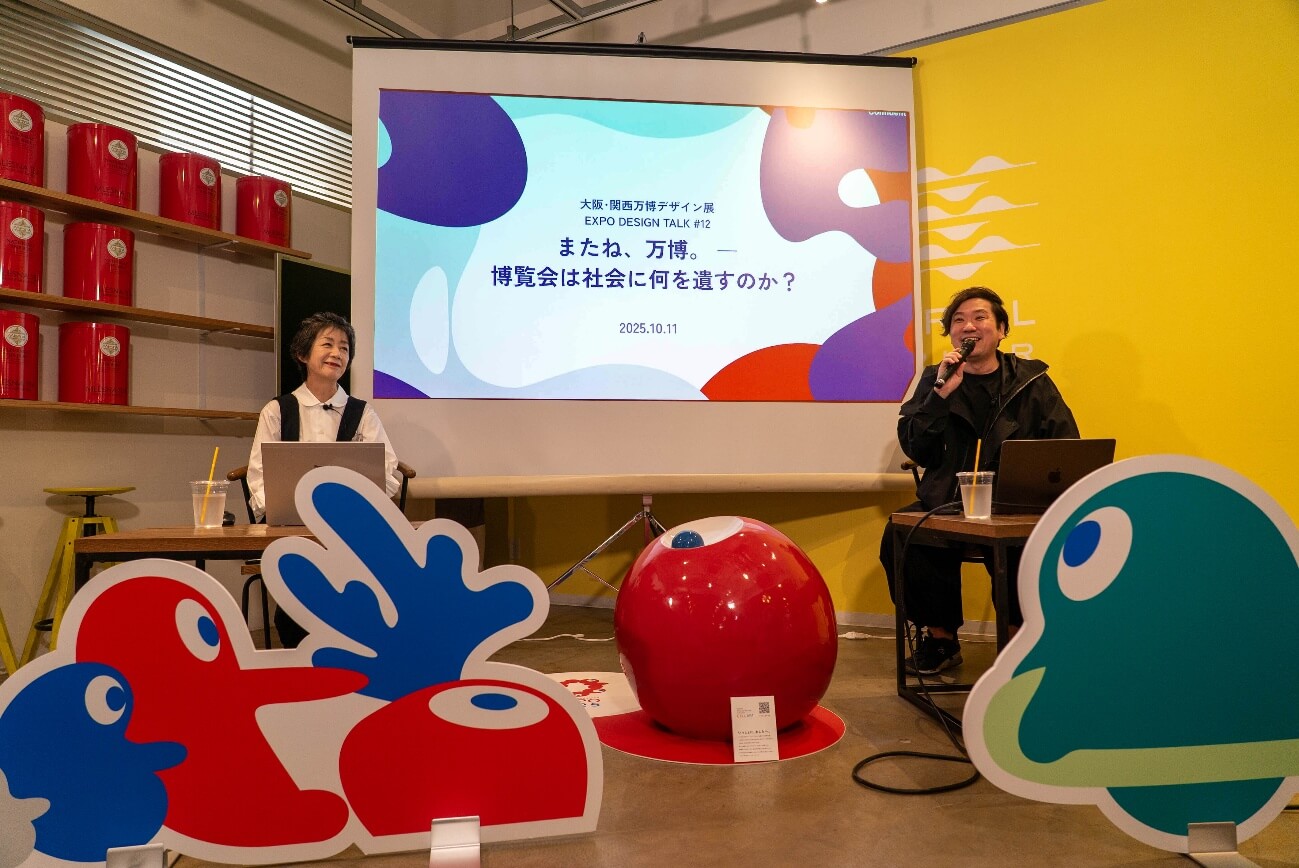
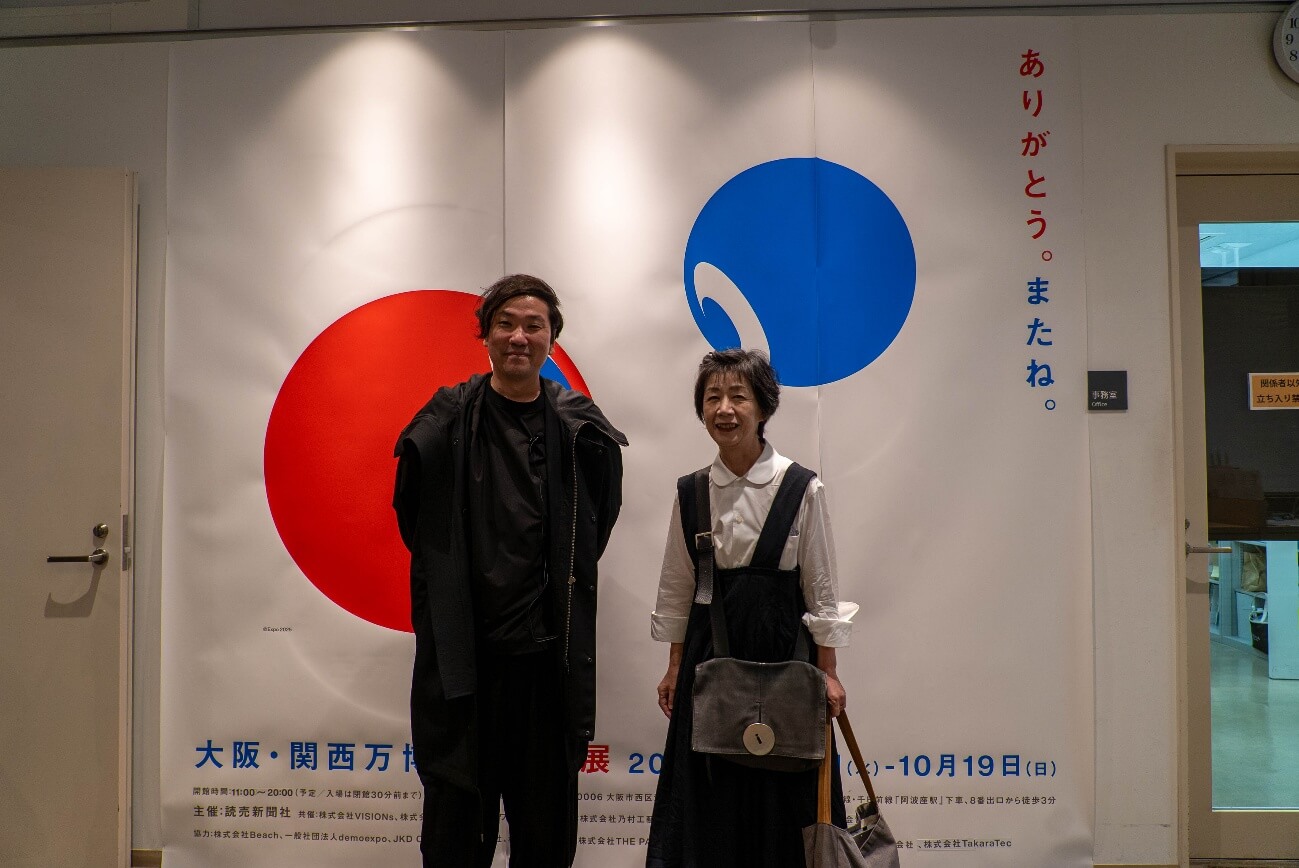
NOMURA Co., Ltd. Atsuko Ishikawa (left) and Kota Hikiji (right). In the foreground are the komyaku who came to listen to the discussion.
1. Collecting materials and leaving them behind
Hikiji
Has the Expo Archives continued to collect materials from past Expos?
Ishikawa
Yes. It all began in 2001 when Terashita Tsuyoshi, a practitioner and researcher of expositions, donated materials from expositions he had collected over a period of about 40 years. The donation was made on the condition that the materials would be useful to society and not kept for personal use. For this Expo, I have been collecting materials at the site as much as possible. I thought that the pamphlets, flyers, tickets, stamps, pin badges, etc. that I collected could serve as evidence of some kind, say, 50 years from now, so I made it a point to take home one or two items whenever I visited the Expo site. Of course, I took a break during the summer, but I visited 13 times during the period.
Hikiji
Even if you don't feel that the materials you collect are particularly meaningful at the time, when you look back on them later, you'll be able to look back and think, "These materials marked a time of change." This year's Expo was also said to be one in which paper would be eliminated, but in the end, there were still pamphlets. This, too, can be discussed in a variety of contexts and is evidence of a transitional period.
Ishikawa
That's right. For example, the "Lost Child Patch" at the 1970 Osaka Expo was a patch that parents and children could tear off and each hold, but this time it has been changed to a registered "Lost Wristband." Parents register information using a QR code. It comes in five colors, including pink and green, and features a pattern of 12 Myaku Myaku figures in various poses. These days, parents can track their children's whereabouts using GPS, so the concept of a "lost child" may no longer exist in 10 or 20 years. I believe that the Lost Wristband itself will become a document that reflects the times.
Hikiji
I also have a child in elementary school, and I can see his location on my GPS smartphone. It reduces the feeling that he's lost, which gives me a sense of security. As the accuracy of location detection continues to improve, I'm sure that this sense of security will continue to increase.
Ishikawa
Several such systems were introduced at the venue of this Osaka-Kansai Expo.
Hikiji
The Expo is a mirror that reflects the current state of social change.
2. What is the Expo? / Key points of history
Ishikawa
Let's start by talking about what an Expo is. An Expo is an international exposition that can only be called such after a country that wishes to host it has been approved by the general assembly of the Bureau International des Expositions (BIE) in Paris. At the head of the flags at the entrance to the venue are the Japanese flag and the Expo mark, but this mark was designed by a Japanese university student the year before the 1970 Osaka Expo; prior to that, the mark itself did not exist. The Olympics are hosted by cities, while Expos are hosted by countries. The Tokyo Olympics are "hosted by Tokyo," but Expos are national projects called "World Exposition, Japan."
The first World's Fair was held in London in 1851. With the intention of showcasing the success of the British Empire's Industrial Revolution to the world, and with the hidden intention of gathering its colonies in London for a panoramic view, exhibits from each country were concentrated in a collective pavilion called the Crystal Palace, rather than individual national pavilions. Portable steam engines and rotary printing demonstrations were featured, marking the widespread adoption of printing throughout the world. The Paris World's Fair of 1900 was called the "World's Fair within an Exposition," and a "moving walkway" was installed within the venue. The exhibits also symbolized the end of the century, featuring horse-drawn carriages and automobiles side by side. The second modern Olympic Games was held in conjunction with this Paris World's Fair, and the World's Fair's prize system led to the awarding of Olympic medals. Gold, silver, and bronze medals were awarded first at the World's Fair. The first unifying theme was established at the 1933 Chicago World's Fair, with the theme "A Century of Progress." This theme continues from the 1970 Osaka event, which was titled "Progress and Harmony for Mankind," to this year's event, which is titled "Designing a Future Society for Life."
Hikiji
Words like "progress," "evolution," and "future" are often used in themes for World Expos.
Ishikawa
Two other World's Fairs had a strong influence on the 1970 Osaka Expo. The first was the 1964-65 New York World's Fair, which was not officially recognized by the BIE and therefore did not include exhibits from the Soviet Union or the United Kingdom, both of which are regular Expo participants, but which featured many American corporate pavilions. Walt Disney produced four of the pavilions at the Fair, and it has been praised as "the greatest show of the 20th century, with a focus on enjoyment." The speed of the "It's a Small World" ride, which was later moved to Disneyland, was so exquisite that it left visitors wanting to see just a little longer, demonstrating just how much it could delight audiences.
The second was the Montreal Expo held in 1967, where video exhibitions flourished. By that time, it had been decided that Osaka would be hosting the Expo in 1970, and this had a major impact on the Osaka Expo. With Asia's first Expo just three years away, people from all sectors of Japanese industry traveled to Montreal to inspect the event, and the display industry, including NOMURA Co., Ltd., even chartered a plane to go on the tour.
NOMURA Co., Ltd. was ultimately involved in 16 pavilions. I visited the Mitsubishi Miraikan Pavilion at the age of 12 and was awed by the 360-degree magma projections and the light and sound. The stormy ocean scene, which took us around the rooms on a moving walkway, combined with the rocking of the ship—it was unforgettable. I remember being surprised when I first learned after joining the company that NOMURA Co., Ltd. was involved in the Osaka Expo. This was because our company's philosophy was to remain behind the scenes and not appeal to society, but instead to create the best products. I hope I have been able to explain how the Expo, which began as a question of "how to display things," has changed to a question of "how to help visitors understand and enjoy them."
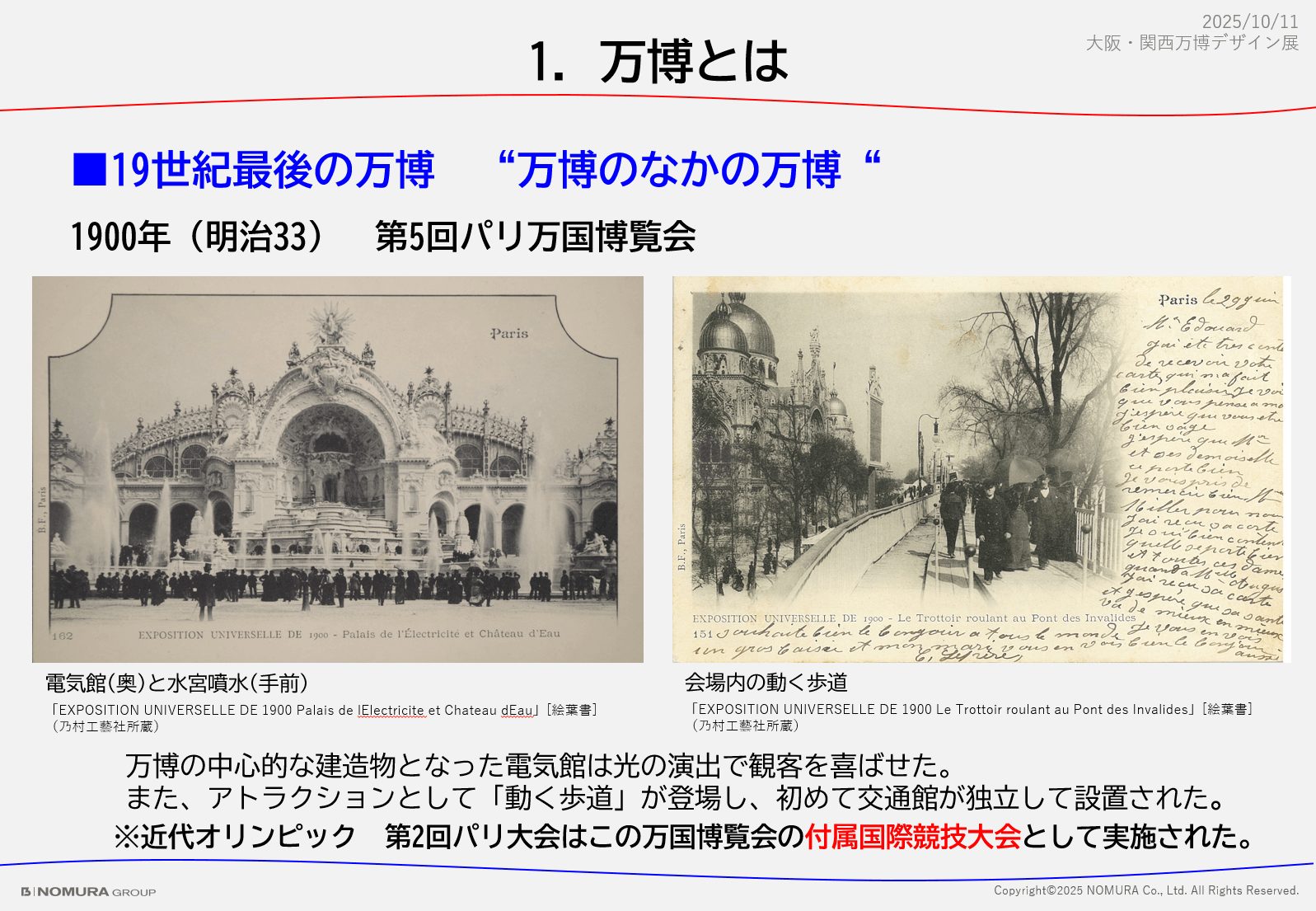 Slide used during the discussion: "1. What is the Expo?"
3.Reflections on the 1990s andthe turning point of the 21stcentury: the design system born this time at the Expo
Ishikawa
In the 1990s, a series of Expos failed from a business perspective, sparking debate about whether Expos were really necessary. The BIE then changed course and redefined the direction of 21st-century international expositions in 1994 as a forum for resolving global issues. Following this trend, the 2005 Aichi Expo (nicknamed "Aichi Expo") was held, and as a new exposition for the 21st century, it introduced new mechanisms and technologies such as citizen participation, a cyber Japan Pavilion, and cleaning and security robots.
Hikiji
My impression of the Osaka-Kansai Expo was that it had a huge impact, something that is unique to the age of social media.
Ishikawa
Another distinctive feature of the Osaka-Kansai Expo was the appearance of unofficial maps and other information on social media.
Hikiji
Although the initial excitement for this Expo was limited, the experiences of people who actually visited were shared exponentially on social media immediately after the opening, which changed the atmosphere in society. Derivative creations were one example of this, and Komyaku, with its loose protocol of "all you need is an eyeball," attracted the participation of a wide range of creators, turning it into a movement that also included AI generation.
Ishikawa
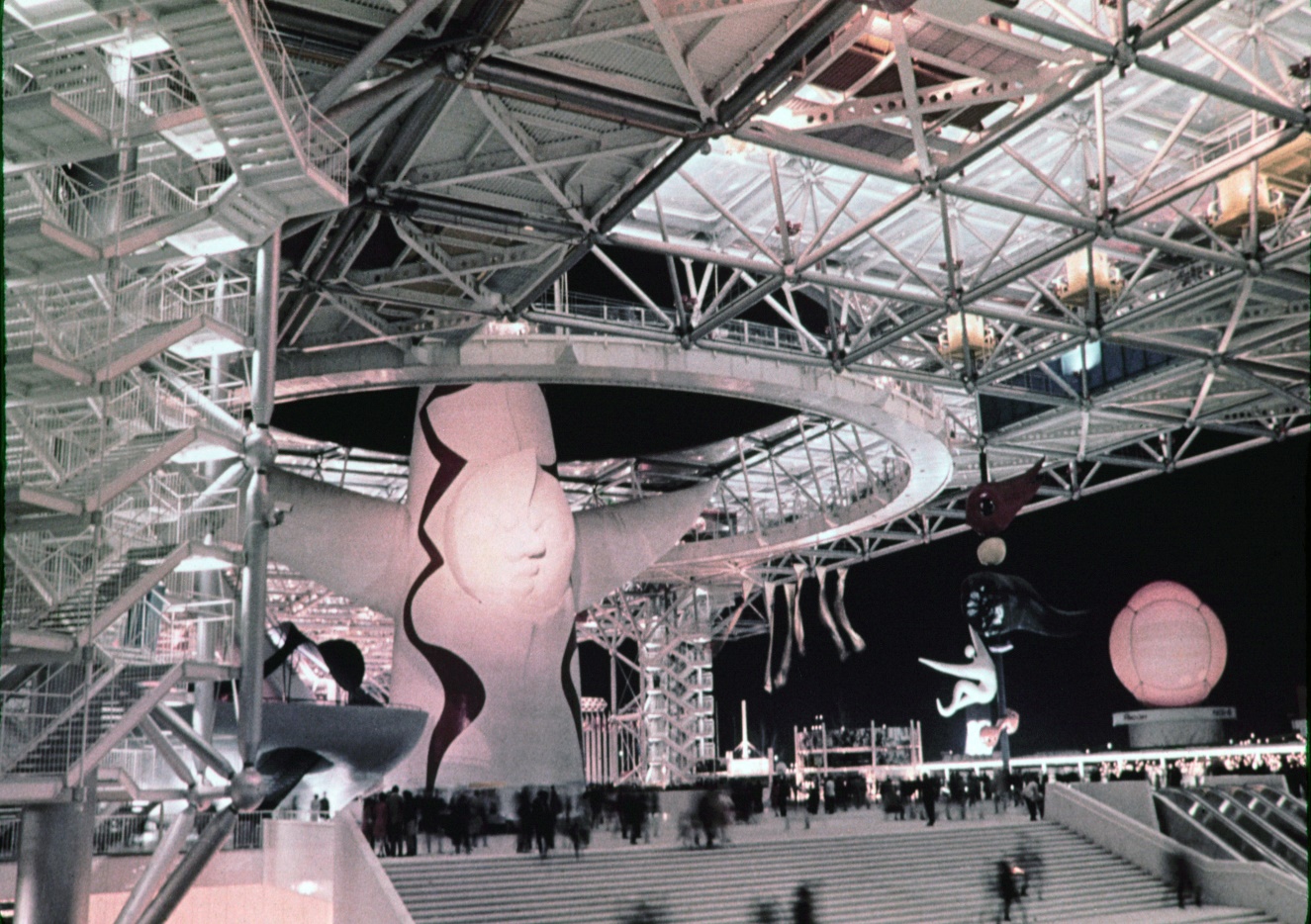
The previous Osaka Expo in 1970 still had a strong national flavor, and the design was basically top-down, with derivative works not being permitted, as was the case with the Tower of the Sun. With the advent of the Internet, it feels like the distance between the Expo and the general public has narrowed, with people saying, "We're making this Expo ourselves."
In the 19th century, the Expo was mainly held in Europe, but with the 1970 Osaka Expo, it began to be held in Asia, and since the 21st century, it has increasingly been held in the Middle East. It can be said to be "the world's largest cultural event," with powerful countries stepping up to the plate at the time. Taro Okamoto described it as a "festival."
Hikiji
The design for this Osaka-Kansai Expo is also not a top-down approach, but rather one that blends diverse perspectives and is "centerless." The venue decorations are not just made up of sheets; some were painted by artists themselves, and some were completed in collaboration with craftsmen. When I first saw the venue without any decorations, I thought it was beautiful, but this is because I believe that cities of the future should not be all about convenience and efficiency, but should exude human warmth and creativity.
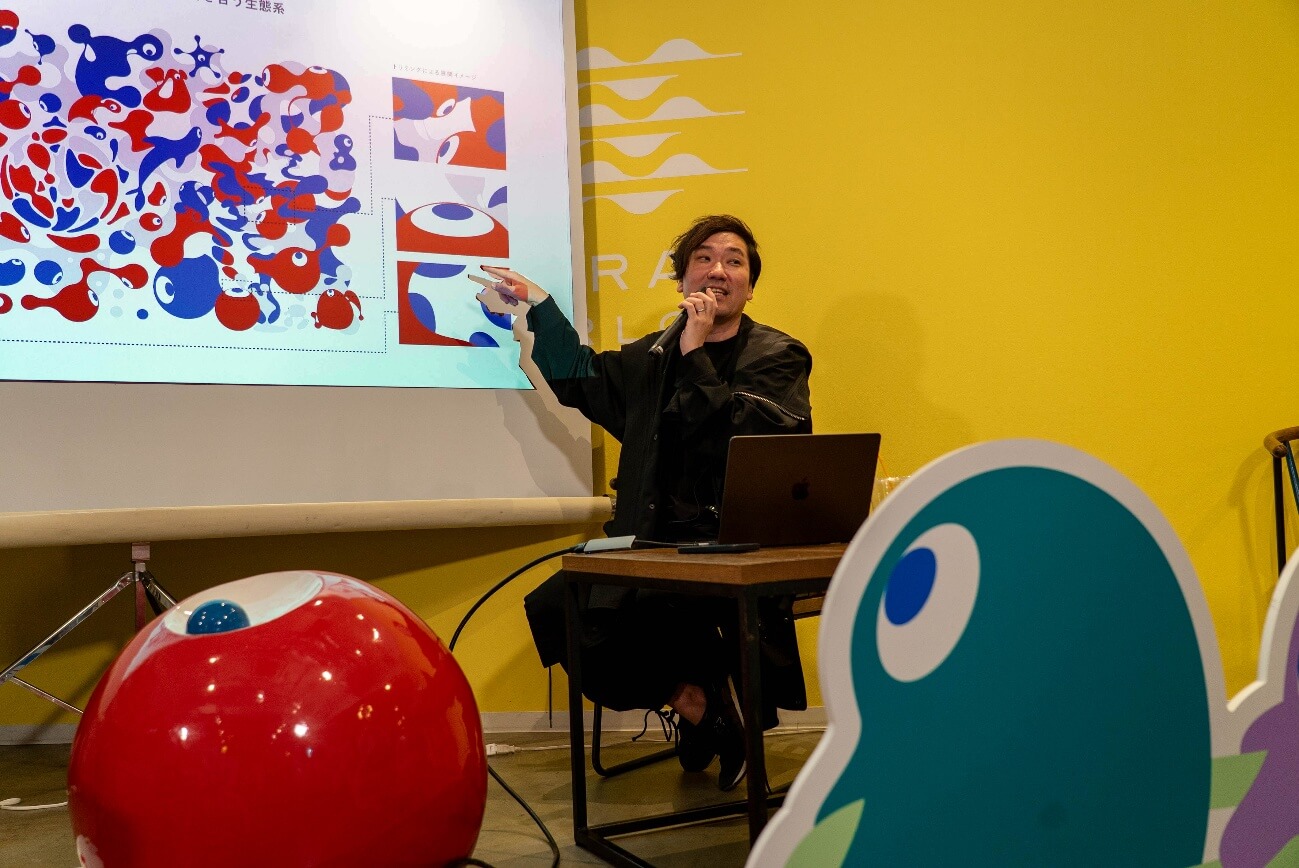
The logo was created by designer Shimada Tamotsu, and is a tribute to the Tower of the Sun, with the number of eyes matching the 1970 logo. The "Tree of Life" was at the core of my idea when creating the key visual, and I expressed this worldview as an ecosystem where diverse life forms live, rather than just humans at the center, using "human life = red, natural life = blue, new life originating from technology = gray." I wanted to depict a society where humans, nature, and technology coexist and mingle.
Ishikawa
A world without a center is amazing.
Hikiji
For example, the unofficial map by "Tsuji-san" and derivative works of Komyaku were created by involving a variety of people rather than a top-down approach, which led to the emergence of diverse perspectives. By deciding on a protocol that Komyaku only needed to have an eyeball, many people created a variety of Komyaku goods and uploaded them to social media. Some people even released prompts for generating Komyaku using AI. I believe we have succeeded in designing a form of participation for the general public that differs from the designs of traditional national projects.
4. NOMURA Co., Ltd. Ltd.'s involvement with the exposition and its collection
Ishikawa
NOMURA Co., Ltd. began producing props for theaters in 1892, and went on to create backdrops for chrysanthemum dolls. At the Tokyo Taisho Exposition, a domestic exposition held in Ueno Park in 1914, the company exhibited a 666-story pavilion called the "Living Doll Museum," and at the 1939 San Francisco World's Fair, the company was in charge of the exhibits for the tourist corner of the Japan Pavilion. Since then, the company has been involved in over 200 exposition-related projects, with the Osaka-Kansai Exposition being its 201st.
In 2001, Mr. Tsuyoshi Terashita donated nearly 10,000 items, which were categorized and compiled into a database over the course of three and a half years. These items are now publicly available as the "Exposition Materials Collection." This public access has attracted numerous researchers from Japan and abroad to investigate. With the decision to hold the Osaka-Kansai Expo in 2018, the company opened an "Expo Gallery" within the company in January 2023. Unfortunately, since it's located inside an office, it can only be accessed by reservation via employees. NOMURA Co., Ltd. 's collection is unique in that it not only contains official records, but also includes items that would normally be discarded, such as chopstick wrappers from Japan's first conveyor-belt sushi restaurant, paper cups from the Aichi Expo, and empty cans and bottles, providing a comprehensive history of Japan's expositions. Materials lose their meaning once they reach a certain volume. This is why we are determined to preserve materials related to the 2025 Osaka-Kansai Expo.
Hikiji
As someone involved with the Expo, I'm pleased to see that items that would otherwise be overlooked in the official archives are being collected from a different perspective.
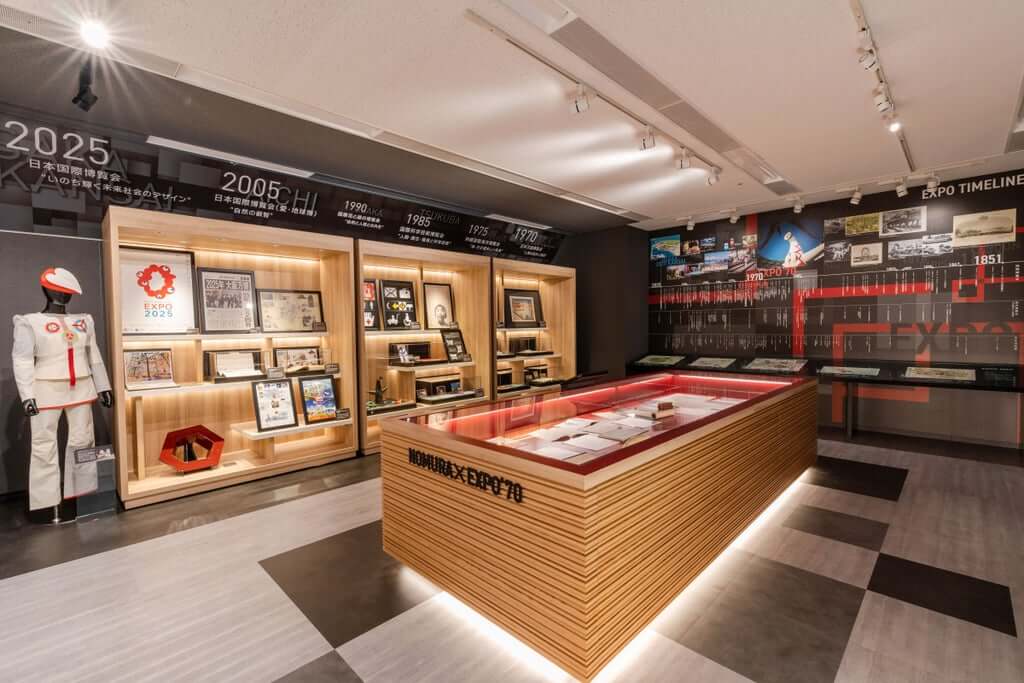 EXPO GALLERYat NOMURA Co., Ltd. Osaka Office(closed to the public)
Ishikawa
One of the attractions of world expos is being able to see creative works from around the world all in one place. In terms of architecture, the Eiffel Tower was built at the 1889 Paris Expo. It seems that it was unpopular with Parisians at the time. In terms of physical exhibits, the 1970 Osaka Expo exhibited moon rocks, which caused a stir. The 2025 Osaka-Kansai Expo will also exhibit Martian rocks. At the 2005 Aichi Expo, the Jordan Pavilion offered the opportunity to float in a pool filled with Dead Sea water, and this year's exhibit included desert sand. In terms of art, Picasso's "Guernica" was exhibited for the first time at the Spain Pavilion at the 1937 Paris Expo, and at this year's Expo, the Italian Pavilion exhibited the "Atlas of Farnese," which was said to be a secret. The appeal of seeing real works remains as strong today as it was in the past. Finally, it's said that world expos offer access to a wide range of fields in human life, including diplomacy, music, economics, art, science and technology, and design.
Hikiji
In the context of design, the Olympics and the World Expo are also the venues where historic masterpieces have been created. I admire them, but this time too, I felt the same pressure throughout.
5. Changes in Life Brought About by the Expo
Ishikawa
The 19th century world expositions brought about changes in our lives, including the elevator, sewing machine, washing machine, and grand piano. It is said that the arrival of the loud grand piano made it possible to hold piano recitals in various theaters. At the 1970 Osaka Expo, the Telecommunications Pavilion's demonstration of a "wireless telephone" (for domestic calls) is said to have been the beginning of mobile phones. The concept of eating out also changed, with the arrival of Kentucky Fried Chicken in Japan for the first time and the opening of the first conveyor-belt sushi restaurant. Back then, people wore formal attire to eat out, but nowadays, it's easy to go out in casual attire. Such changes were also seen in fashion.
Immediately after the opening (of the 1970 Osaka Expo), men wore suits, women wore kimonos or suit-like clothing, and children also wore formal attire, but towards the end people started wearing casual attire like T-shirts and jeans. Influenced by the casual attire worn by foreigners at the Expo site, everyday clothing in Japan changed after the Expo closed. The pavilion uniforms have also attracted attention, with Koshino Junko, who designed the uniforms for Takara Beautillion in 1970, apparently designing them based on the clothes she herself would want to wear. The uniforms for this year's Osaka Healthcare Pavilion were apparently designed with a "future unbound by gender or age" in mind. It can be said that everything that appears at an Expo has the beginning of the future.
Hikiji
Culture, jobs, technology... It's fun to imagine what of the things you saw at the Expo will appear in your daily lives. As an output of the Expo, which serves as a mirror of the times, it will not only have tangible forms, but will also transform concepts and ways of thinking, and this will appear in cases such as those linked to fashion.
Ishikawa
The same can be said about design. For example, pictograms first appeared at the 1964 Tokyo Olympics and became popular after the 1970 Osaka Expo.
Hikiji
It is said that the illustrations were designed so that foreigners who do not understand Japanese could understand them.
Ishikawa
However, some photos from that time show a piece of paper with the word "Toilet" pasted under the male and female toilet pictograms, suggesting that this was a transitional period before toilets became widespread.
6. Reality,virtuality, andsocial media
Ishikawa
Although this year's Osaka-Kansai Expo will have a virtual venue, the overwhelming majority of people seem to have enjoyed themselves at the real venue. What is the appeal of a real venue?
Hikiji
I believe the Virtual Expo was planned amid the current COVID-19 pandemic, and many people are actually enjoying it. Before the Expo itself opened, some people questioned whether an online event would suffice. However, this time, I once again felt that there was something special about a real-life event—the feeling of the wind on my skin as I walked under the large roof ring, and the atmosphere of the sunset. The soundscape at the venue was also linked to weather sensors, changing depending on whether it was raining or cloudy. The concept is "music performed by humans, nature, and technology." Rather than choosing between real and digital, I believe it's important to design new experiences by "designing combinations." I believe digital should not only be used for rationalization, but also to preserve humanity in society. Using digital technology for the sake of logic results in uniform output, but incorporating irrational processes can ensure diversity. I believe it's important to design a society in which people can live without losing their humanity.
Ishikawa
NOMURA Co., Ltd. also makes its living in real spaces, so I was relieved to see that while virtualization is progressing, Mr. Hikiji is also thinking about the importance of the real world.
Hikiji
I'm often asked, "Are the sounds of insects and frogs included in the soundscape?" But there are some places where they are and some where they aren't. In fact, in most places the sounds are mixed with local environmental sounds, such as the chirping of insects, and it is only by mixing them that the sound as a whole becomes organic. This Expo was not just a way for the organizers to disseminate information; it also gave rise to a culture of "sharing," where visitors voluntarily filled in the gaps, such as "making maps" and "spreading derivative works." It's like a sense of wholeness created by top-down and bottom-up approaches, and I feel like we're seeing the beginnings of new relationships between humans and nature in the case of the sound system, and between the state and citizens in the case of information dissemination.
Ishikawa
It was only after the Expo was held that we realized this, and rather than it being something that was anticipated in advance, I think that this Expo was "the catalyst for the fusion of real and digital," as people who actually experienced it shared their experiences on social media, creating a cycle in which others who saw them wanted to experience it in real life.
Hikiji
At the 2005 Expo in Aichi, the internet was available, but social media hadn't yet become widespread. This time, I believe that the headwinds before the opening caused a sudden change in the atmosphere in society after the opening. I think that even those who had been supporting the event before the opening were anxious because there was no physical presence, but once it actually opened, each and every fan became a spokesperson and spread the diverse charms of the event on social media, which I think can even be said to have changed the atmosphere in society.
Ishikawa
This was something that would have been unthinkable at the 1970 Osaka Expo, when the only media available was television. History repeats itself. Before the 1970 Expo opened, a 1968 magazine article asked, "Is it really necessary?", and a 1969 magazine article asked, "We can still stop now," but once the Expo opened, an overwhelming number of visitors flocked to the event. It's similar this time around.
Hikiji
It took some time for both the Tower of the Sun and Myaku Myaku to be accepted by society after their initial announcement.
Ishikawa
I think this is a good example of how there are clues in the past.
Hikiji
Regarding citizen participation, the Expo Association also created a framework for EXPO 2005 Aichi, Japan, but I think what was distinctive this time was the spontaneous actions of citizens. In addition to the traditional top-down approach, I think we saw a new form of public service existing between the state and citizens, where someone voluntarily created something that citizens lacked and "shared" it, which was shared and enjoyed by the world. While the state lacked the resources to provide full services, citizens voluntarily filled in the gaps, creating a state in which "life shines."
Ishikawa
It's fun to actually go to the venue, and unexpected happenings like striking up a conversation with the person next to you in line can happen. I think that's one of the charms of the real thing. On the other hand, I also check the internet the day before I go to see what people are talking about at the moment. I think this Expo was an experience where you could enjoy the best of both worlds.
Hikiji
I believe that it will be up to future generations to decide what kind of impact the changes that occurred at this Expo will have on society, and I look forward to seeing how they will look back on it. And with that, our time is up. Thank you for today.
(End of conversation)
Finally, leaving questions open and open the possibilities
What became clear from this conversation is that the Expo was not a place to present the correct answer of a "defined future society," but rather a place to allow the seeds of diverse possibilities to germinate and then present them to society in a single venue. This time in particular, after the opening, social media and the venue interacted with each other, and the "process" of this excitement itself became one answer to the future society. The design system built by Hikiji and the archives continued to be maintained by Ishikawa and other members of NOMURA Co., Ltd., both exist not to fix the future, but to hand over various questions for the future.
What this Osaka-Kansai Expo demonstrated was the "shape of society" that emerges when not only nations, local governments, and businesses, but also individuals, get involved and have fun. The answers to what this Expo left behind will be gathered over the coming years. Perhaps it will be carefully looked back on when a major event is held again (and when there will be considerable resistance). So while we may say "See you, Expo," we can also fill the gaps created by the diversity presented by this Expo with "fun memories and possibilities for the future," and from there, create new "starts of the future"... a positive loop that continues to grow.
Text: Jiro Takano, Osaka-Kansai Expo Promotion Department, NOMURA Co., Ltd. Ltd.
Like this article?
- editor
-
-
First nomlog Editor-in-Chief/NOMLAB Director
I will continue to think about space.