

- text and edit by
- Yuki Shimokuni
The Amami Rabbit Museum, Quru Guru, opened in April 2025.
This is a conservation and research facility that treats and rehabilitates injured Amami rabbits (hereafter referred to as "black rabbits") with the aim of returning them to the wild. However, through hands-on exhibits, visitors can also learn about the ecology of black rabbits, environmental education efforts, and coexistence with humans in a fun way.
We NOMURA Co., Ltd. have been helping create exhibits and develop museum goods for this facility.
In
the previous article, we introduced the development of merchandise, but this time we will report on the facility itself in the form of a conversation with Honorary Director, Professor Fumio Yamada. (Interview date: April 21, 2025)
The Amami Rabbit MuseumQuru GuruMuseum is opening! We hope to revitalize the local economy! Epilogue
Facility name:Quru Guru/About Quru Guru
"Kuruguru" means "dark" in the Amami dialect, referring to the black-brown fur of the Japanese black rabbit. The name also expresses the hope that the rescued rabbits will return to the forest, and that life will continue from parent to child, going "round and round."

The logo, which is shaped like the initials Q and G of Quru Guru, depicts the backs of a mother and her baby black rabbits standing close together.
Now, let's talk about Quru Guru with Honorary Director Yamada Sensei.
Talking with Professor Fumio Yamada, a leading researcher on rabbits, about the "Amami Ecosystem"

Professor Fumio Yamada
He is Honorary Director of the Amami Rabbit Museum Quru Guru and Visiting Professor at Okinawa University. As a researcher at the Forestry and Forest Products Research Institute, a national research and development agency, he has been engaged in research on wildlife ecology and conservation management for nearly 40 years. His research on rabbits has advanced basic ecology and countermeasure research, contributing to Japanese mammalogy and conservation ecology. In Amami and Ryukyu, he pioneered research on rare mammals (Amami rabbits and spiny rats) and invasive mammals (mongooses and domestic cats), pioneering new research fields and laying the foundation for conservation research and government countermeasures. He was involved in the successful eradication of mongooses (declared by the Ministry of the Environment in 2024) from the beginning, contributing to the success for 30 years. His publications include "Labology: The Biology of Hiding and Escape," "An Illustrated Guide to Nearby Life: Rabbits (Supervised)," and "Invasive Mammals in Japan: Management Strategies and Ecosystem Conservation (Edited and Written)."
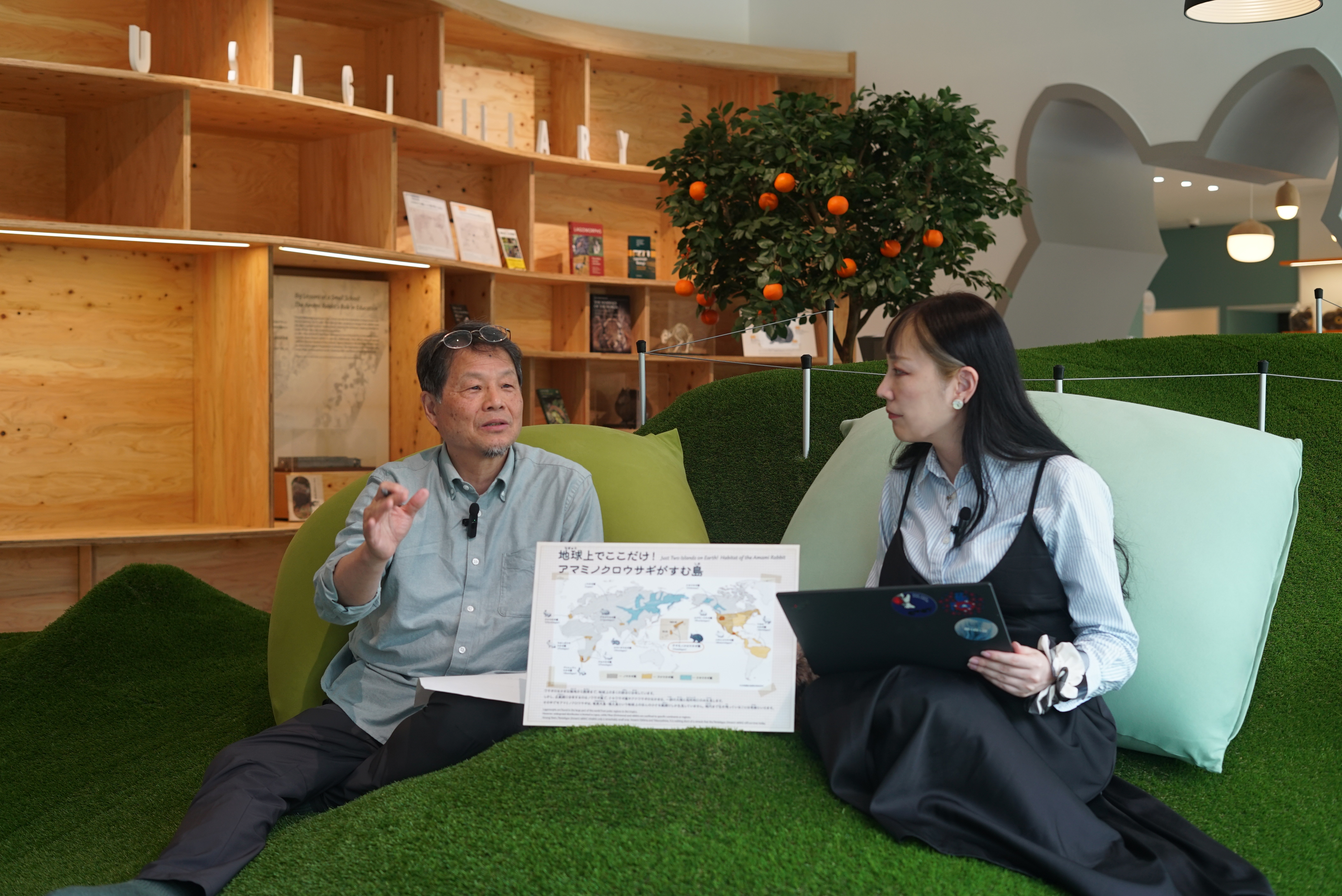
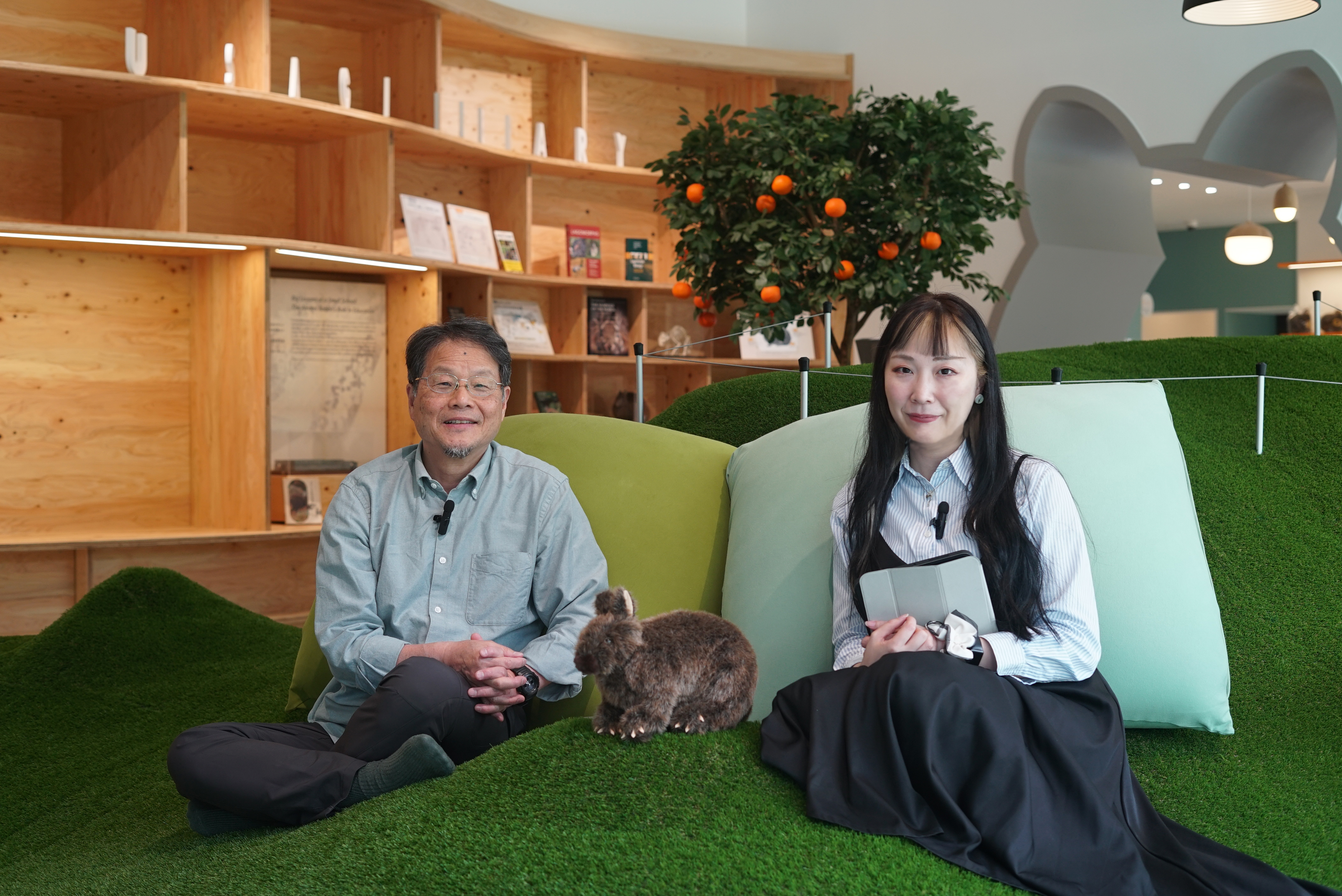 With Professor Yamada Fumio (left) at the newly completed "Kuruguru Hiroba"
Shimokuni:
It's been four years since I met Professor Yamada online in 2021 when the exhibition design began. Quru Guru has finally opened. With Professor Yamada's supervision, the message, graphics, and video that the facility wants to convey have become much more substantial. Thank you very much.
First, I would like to ask you about the black rabbit.
Professor Yamada:
First of all, rabbits are widely distributed from the polar regions to the tropics, and there are about 90 species in the world. They are divided into 29 species of the Pika family, which are small and look like mice, 31 species of burrowing rabbits, which have short legs and are suited to living in holes, and 32 species of hares, which run through the fields with their long legs.
Among the rabbit species, the Japanese black rabbit is found only on the two small islands of Amami-Oshima and Tokunoshima, and has evolved in a unique way.
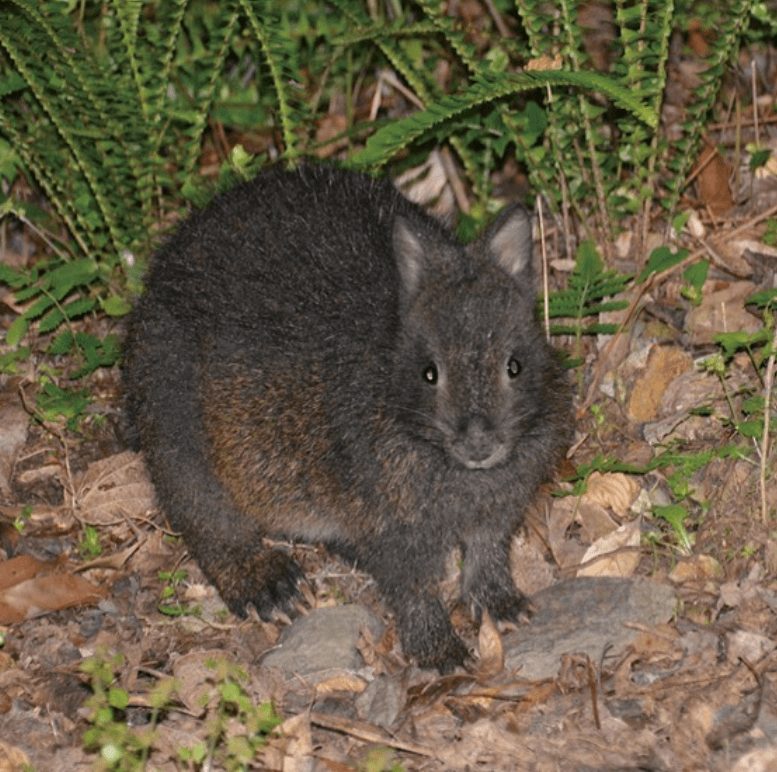
The Japanese black rabbit has small ears, small eyes, short limbs, and black fur.
This is a form of evolution that has adapted to subtropical forests.
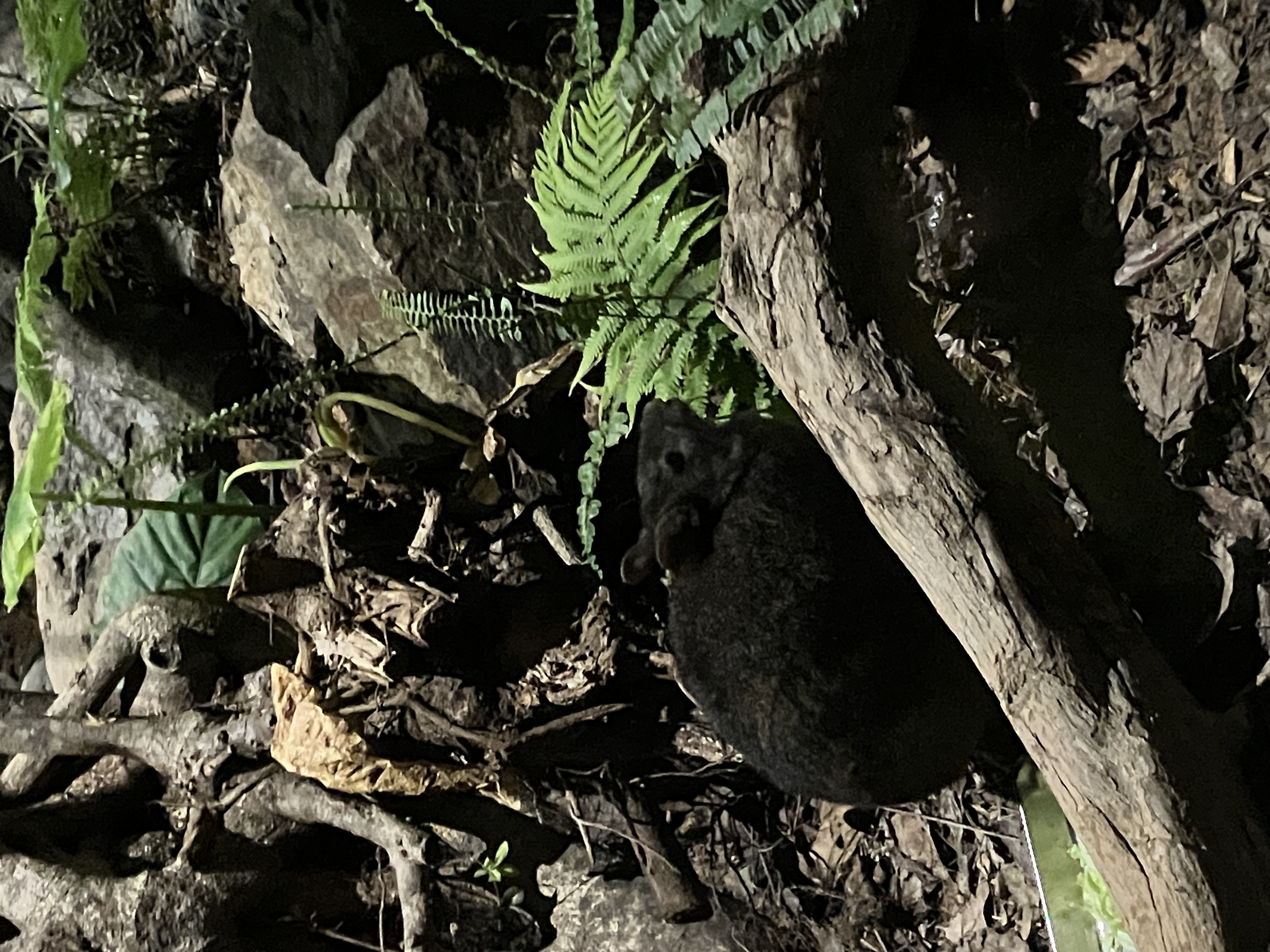 Kenta (male) was rescued from Uken Murata Ken on March 27, 2017. Based on the extent of his injuries, it is highly likely that he was attacked by a cat.
It was decided that the progress of the treatment needed to be monitored in captivity, so the animal was kept in Quru Guru's indoor enclosure, "Yoruniwa."
下國:
クロウサギは、「生きた化石」と呼ばれているように、原始的な姿を残したまま現代に生きる奇跡の動物なんですよね。
夜行性で、短い手足と頑丈な爪は、穴を掘ること、斜面を移動することに適しています。耳が短いのも土の中で暮らすときに邪魔にならないから。一般的なウサギは鳴き声を発しませんが、クロウサギは「ピィ―」と高い声で鳴くことで、仲間とコミュニケーションを取るユニークな生き物ですね。
夜間に車で移動するときや夜の森を観察するナイトツアーに参加すると、道路脇に佇んでいるクロウサギをかなりの確率で見かけます。
元々警戒心が薄いようですが、保護の甲斐もあって最近は遭遇率が高くなりましたね。
Professor Yamada:
They don't get startled when they see people, and they don't run away. Japanese black rabbits are quite docile.
There are no carnivorous mammals on Amami Oshima to begin with. Because they live on such an island, they have no experience of being preyed upon. The fact that there were no carnivorous mammals there also means that they have retained vocal communication.
Primitive characteristics that have been selected out in other rabbits remain in the Japanese rabbit.
Because they have little experience of being attacked, they do not have a strong instinct to be cautious and flee.
Shimokuni:
Even if you park your car and look out the window, they won't run away right away, but will look at you as if to say, "I don't see anything unfamiliar here." Their innocent behavior is very cute.
The exhibition also provides detailed explanations about the origins of Amami Oshima, a unique island with no carnivorous mammals, and the relationship that has led to the formation of a unique ecosystem.
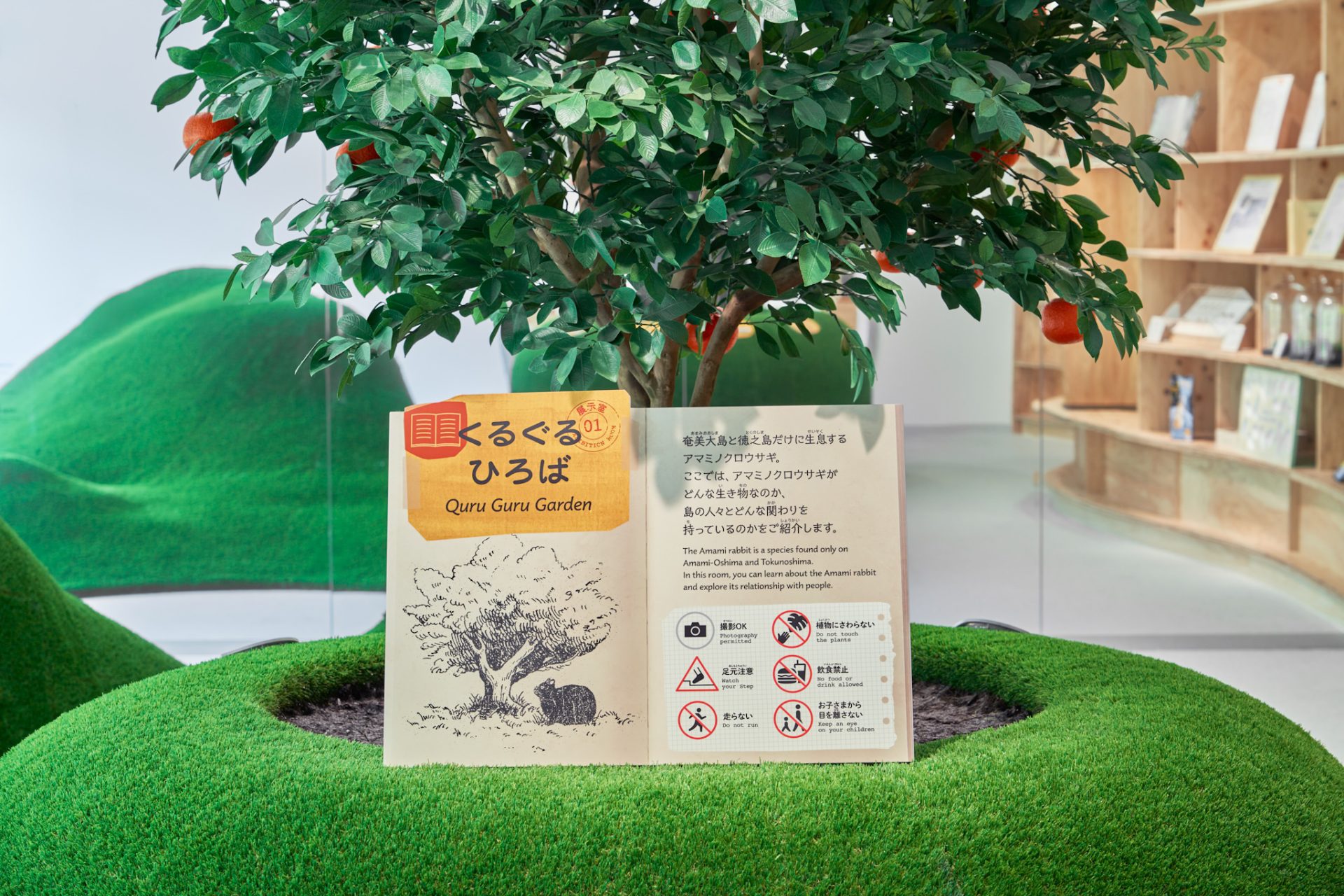
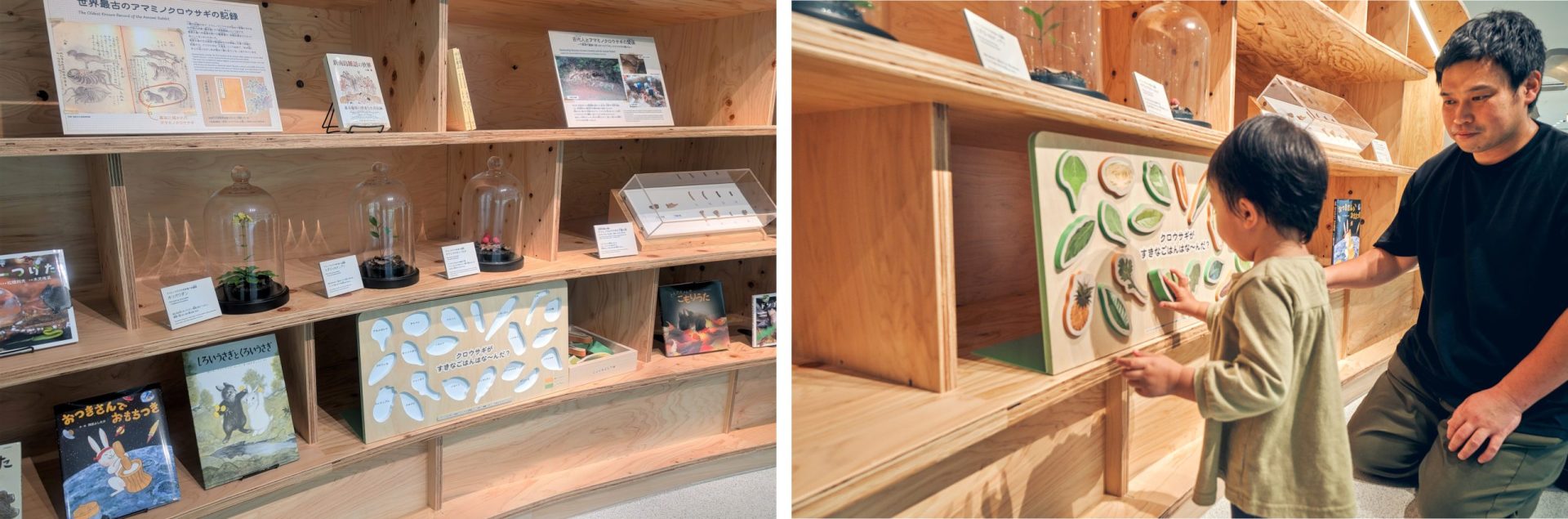 "Kuru Guru Hiroba" where you can learn about the ecology of black rabbits and their relationship with the islanders while having fun
Photography: Sawachika Katsutoshi
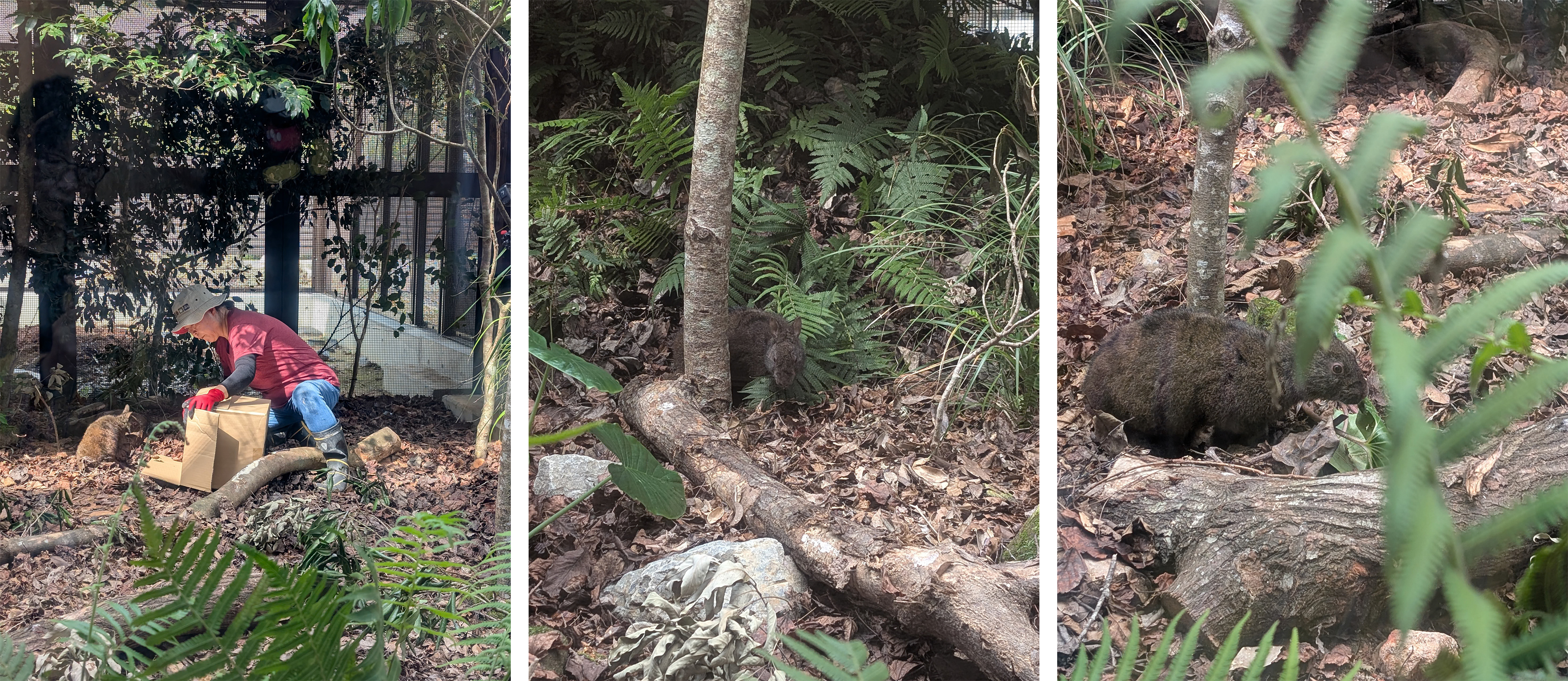 Quru Guruの屋外飼育場「ひるにわ」が完成し、2025年2月18日にQuru Guruにお引っ越しした
ユワン(オス)は2021年2月8日に交通事故に遭い、宇検村の県道上で救護され、島内の動物病院で治療・入院
同年6月28日から鹿児島市平川動物公園で飼育。事故の後遺症で右後足が不自由となり、野生復帰がかなわない
Professor Yamada:
Approximately 7 million years ago, the Japanese archipelago was part of the Eurasian continent.
There is evidence that the ancestors of the Japanese rabbit also lived in the eastern part of the Eurasian continent.
Later, crustal movement caused a depression to form on the continent, which eventually became the sea, and the islands including the Amami Islands (Central Ryukyu) were separated, leaving the ancestors of the Japanese black rabbit behind on Central Ryukyu.
After that, approximately 1.7 to 1.3 million years ago, the Central Ryukyus became completely isolated, and it is believed that the ancestors of the Japanese black rabbit that lived on the mainland became extinct.
Since then, a series of miracles have occurred, and now the black rabbit only survives on Amami Oshima and Tokunoshima.
Miraculously, carnivorous mammals such as foxes, weasels, and ancestors of the cat family did not invade the islands when they separated, so they became islands without carnivorous mammals.
Then, about 30,000 years ago, people began to live on Amami, but they managed to prevent the island's wildlife, such as the black rabbit, from becoming extinct and preserve the forests. An island like this is rare even on a global scale, and it is called the "miracle island."
However, in recent years, people have begun to play a major role in the island's ecosystem.
The number of Japanese black rabbits dropped rapidly when people introduced mongooses to exterminate Habu snakes and allowed pet cats to roam free. Small animals that were not very wary were gobbled up when they noticed something coming. The balance of the ecosystem, where these creatures had lived peacefully and carefree until then, was disrupted by modern human activities and the influence of invasive species.
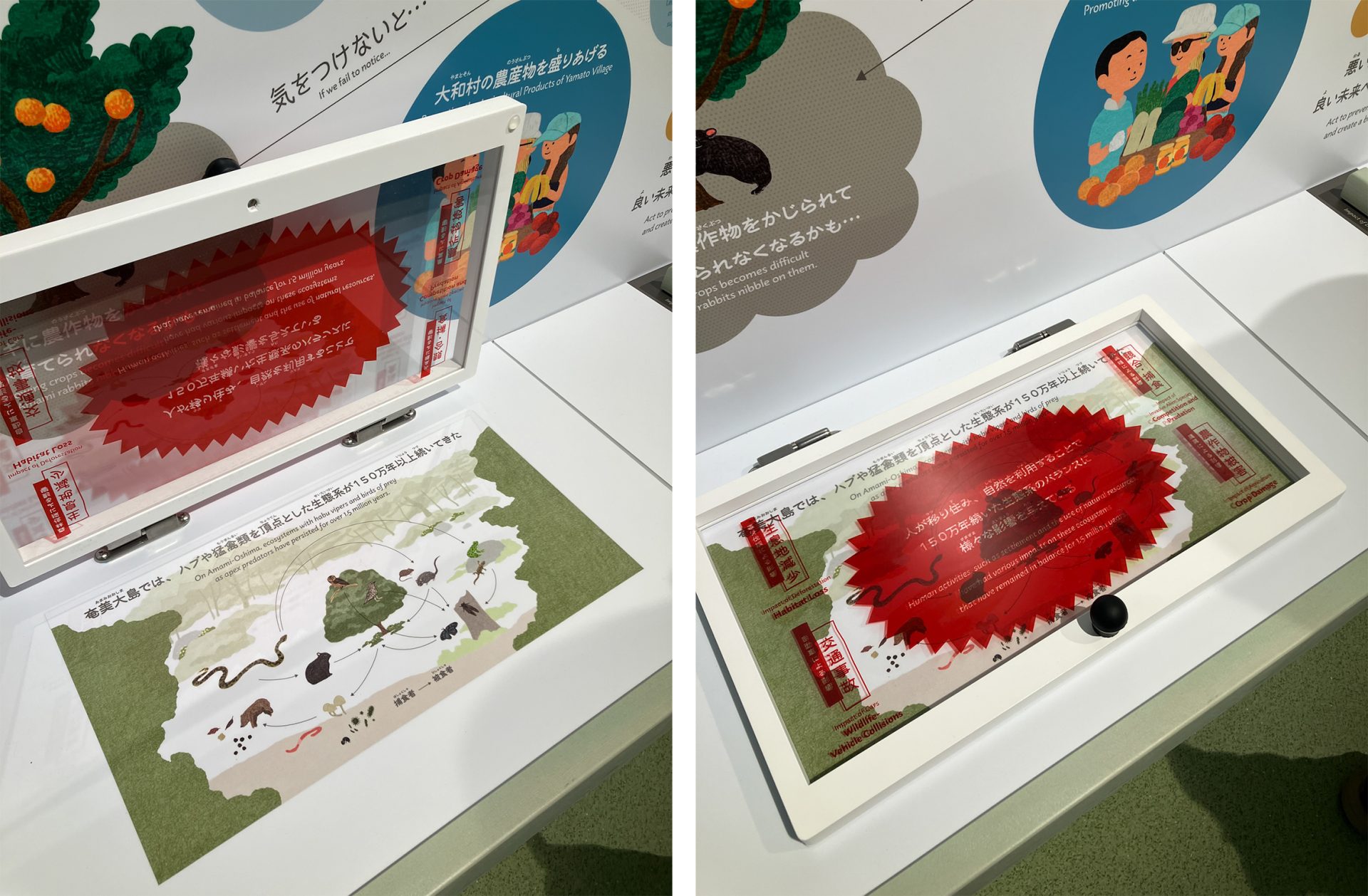 Display of the original ecosystem cycle diagram for Amami Oshima and the ecosystem cycle diagram that has been disrupted by the arrival of humans
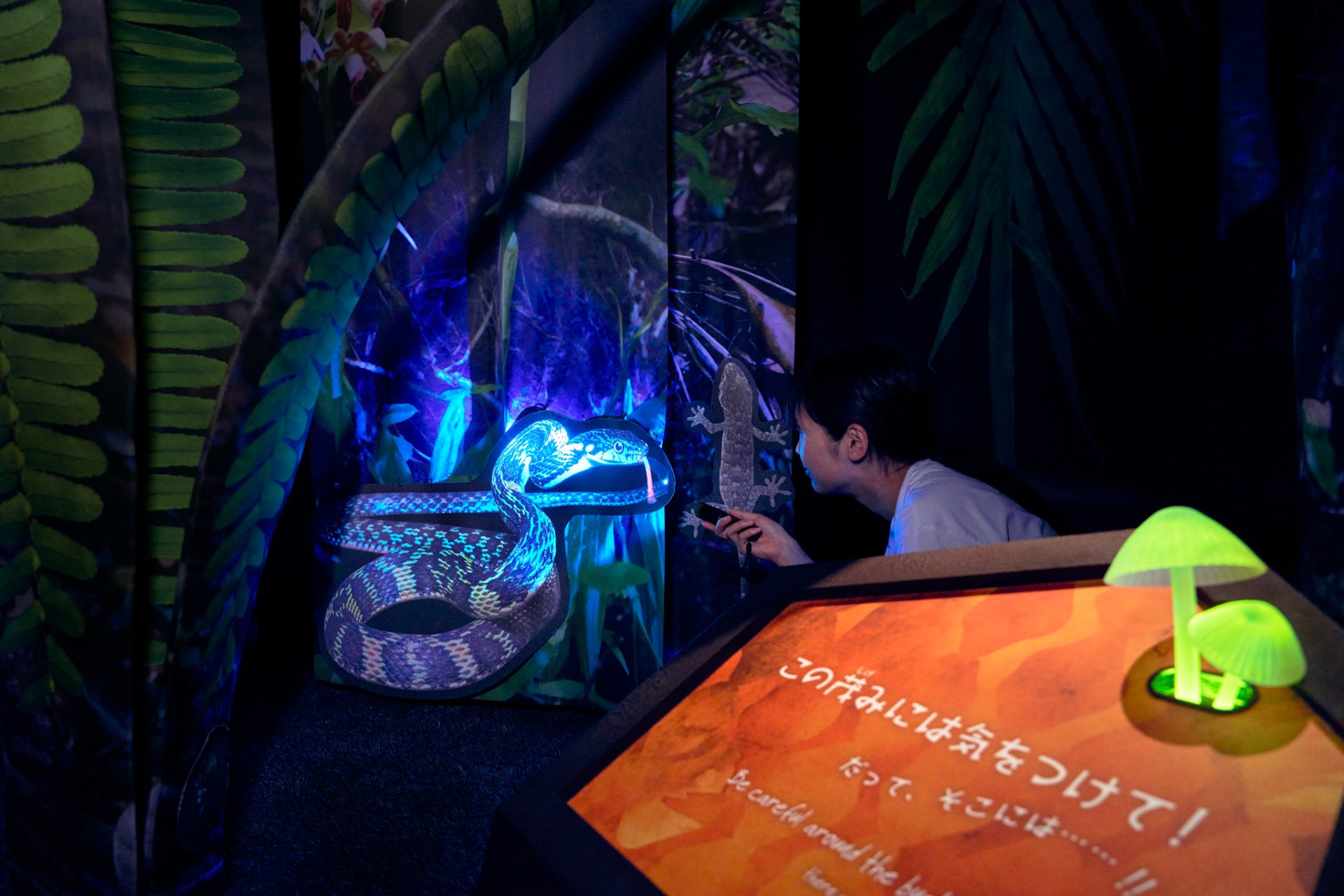 Photography: Sawachika Katsutoshi
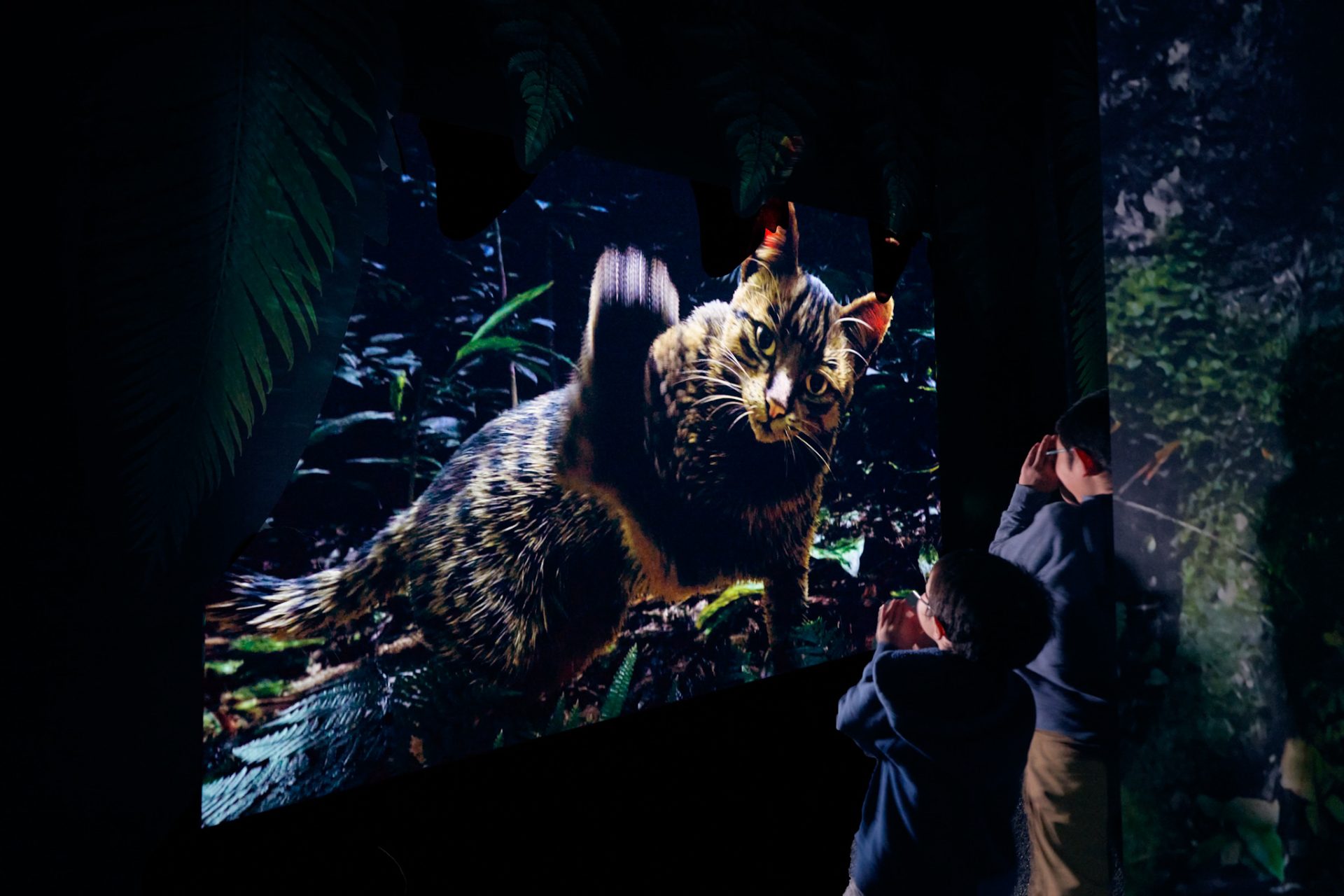 Photography: Sawachika Katsutoshi
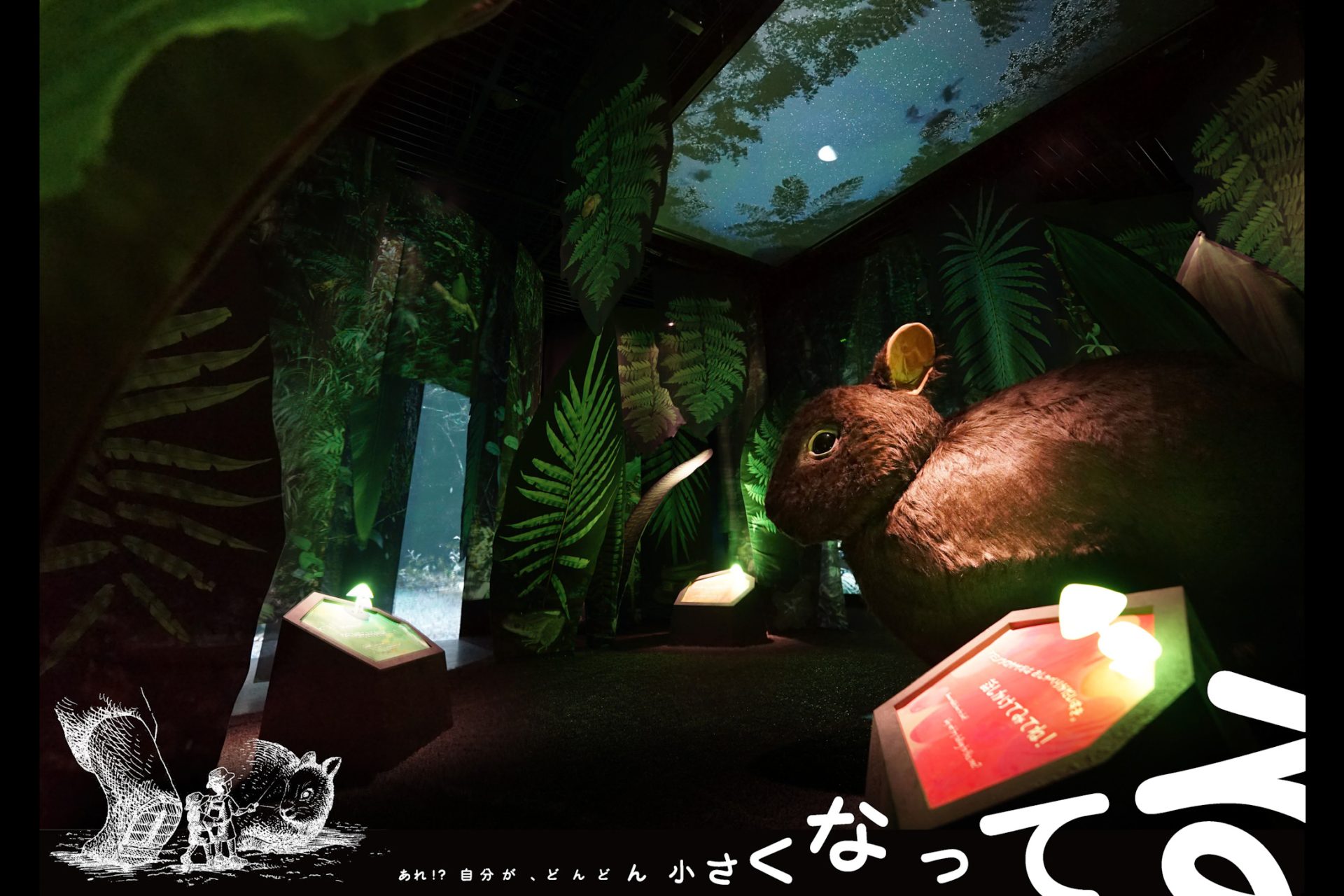
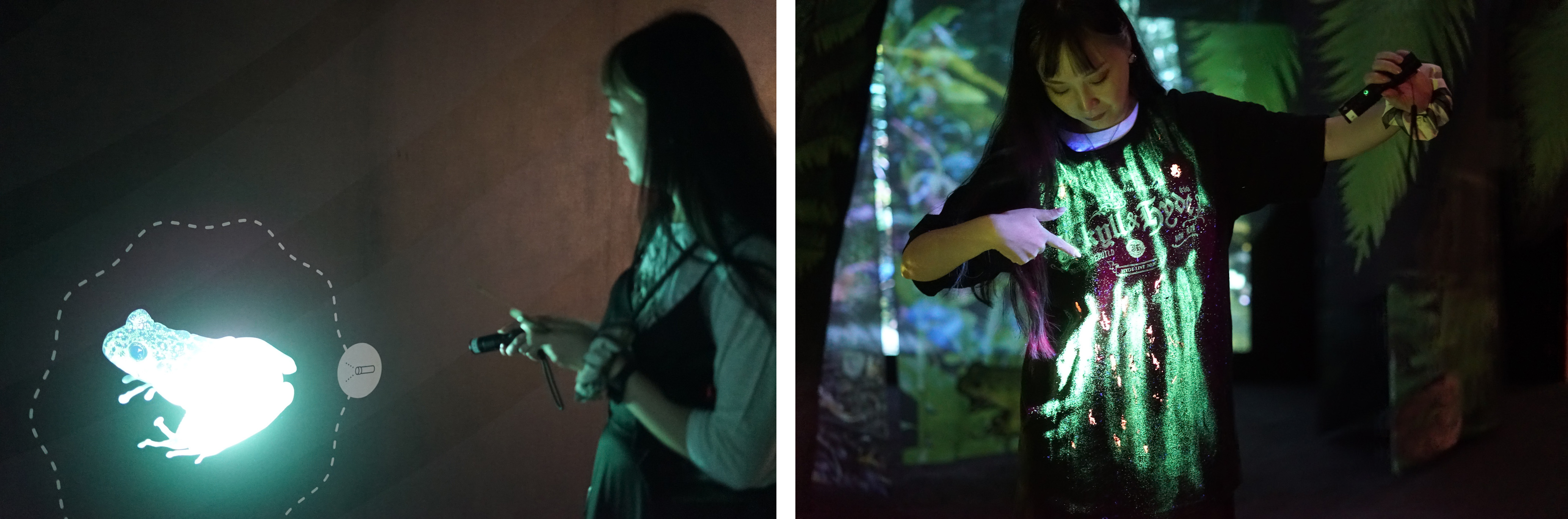 "Kuruguru Forest" recreates the night forest of Amami. You can enjoy a thrilling adventure by searching for creatures in the nocturnal forest using a special light instead of a flashlight.
*Please use a regular flashlight for the actual night tour.
Shimokuni:
There is a general image that Habu snakes are dangerous creatures found on Amami Oshima, but by creating the exhibit together with the teacher, our understanding of Habu snakes has increased.
In terms of the predator-prey relationship, the Habu snake has not evolved to feed solely on the Japanese rabbit. It simply has a habit of biting anything that moves or gives off heat, so it cannot be said with certainty that "the Habu snake is the natural enemy of the Japanese rabbit."
Professor Yamada:
That's right. Habu snakes mainly target rodents, frogs, lizards, newts, etc.
Since the body temperature of mammals is generally around 37°C, the snake reacts to this heat, recognizes it as prey, and reflexively pounces, bites, and injects poison to immobilize the animal before swallowing it.
They can swallow a mouse in one go, but they can't swallow a rabbit the size of a rabbit. They can swallow a young animal, but when it gets bigger, they can't eat it even if they attack it.
Both are nocturnal, but the Japanese black rabbit seems to be active in wide open areas to avoid attacks by the viper.
That's why they are often roadkilled by humans on the roads at night.
Shimokuni:
The key point is that even though the Japanese black rabbit and the viper live in the same forest at night, they are able to coexist by cleverly separating their habitats.
Of course, this "symbiotic relationship" also affects the ecosystem of the entire Amami Oshima island.
The Japanese black rabbit excretes dozens of pieces of droppings in one go, amounting to around 200 pieces per day. I've heard that the small insects that depend on this droppings are the Oshima centipede beetle and the Amami semadaramagusogan, and that the former is found only on Amami Oshima and Tokunoshima, and the latter only on Amami Oshima, making them extremely rare creatures.
The excreted feces is decomposed by insects and microorganisms and returned to the soil, enriching the soil and nurturing the forests of Amami Oshima, where people live, and the soil of the entire island.
This is also an important point about "coexistence between nature and humans" that we want to convey through this facility.
Professor Yamada:
Speaking of ecosystems, there is a dicotyledonous plant called groundnut that parasitizes the roots of other plants and steals their nutrients. It looks similar to a mushroom, but it is not a fungus.
It has recently been discovered that Japanese black rabbits enjoy eating this ground ragwort, and that the seeds get mixed in with their droppings, helping to expand the ground ragwort's habitat.I believe that we still only scratch the surface of what we know about the impact that Japanese black rabbits are having on the ecosystem of Amami Oshima.
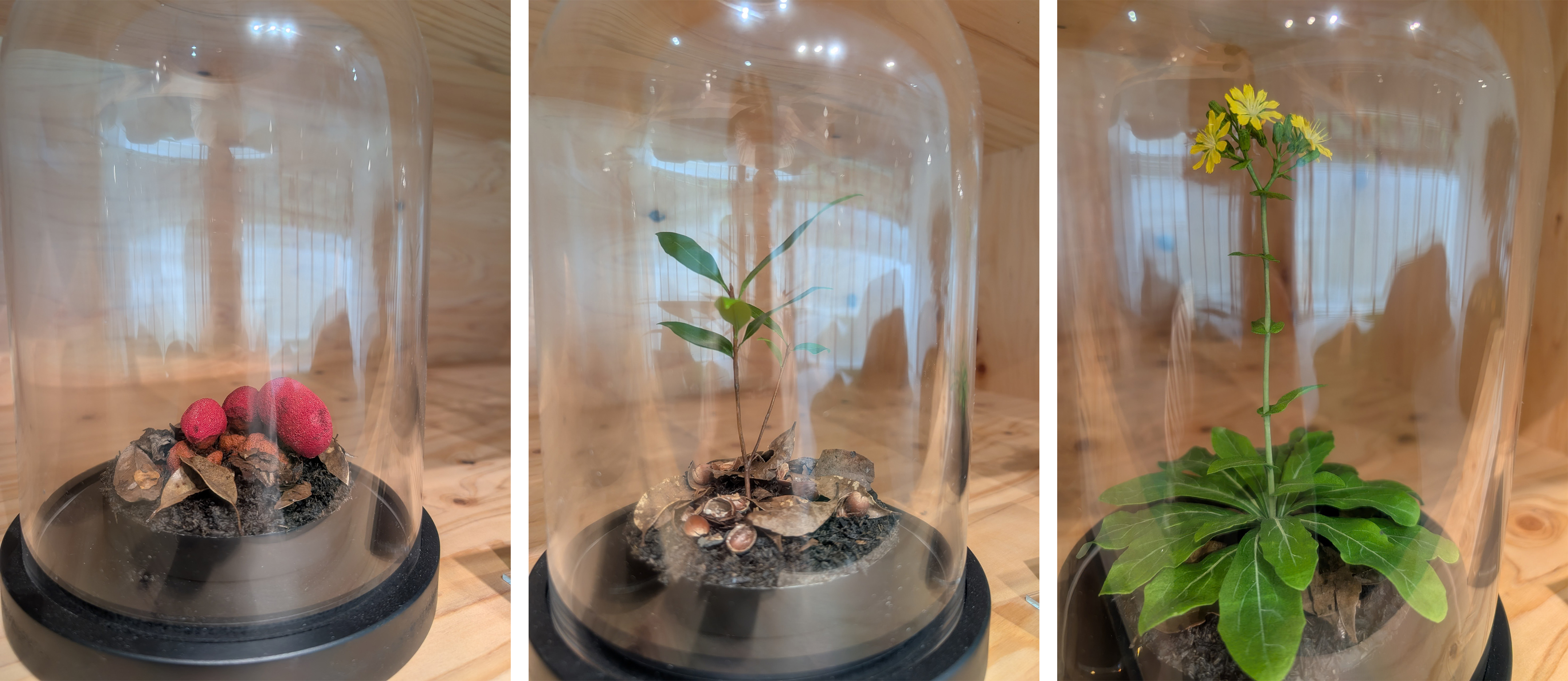 A display of plants that the Japanese black rabbit likes (from left: Yakushima oak tree, Castanopsis sieboldii acorns, and Narrow-leaved dandelion)
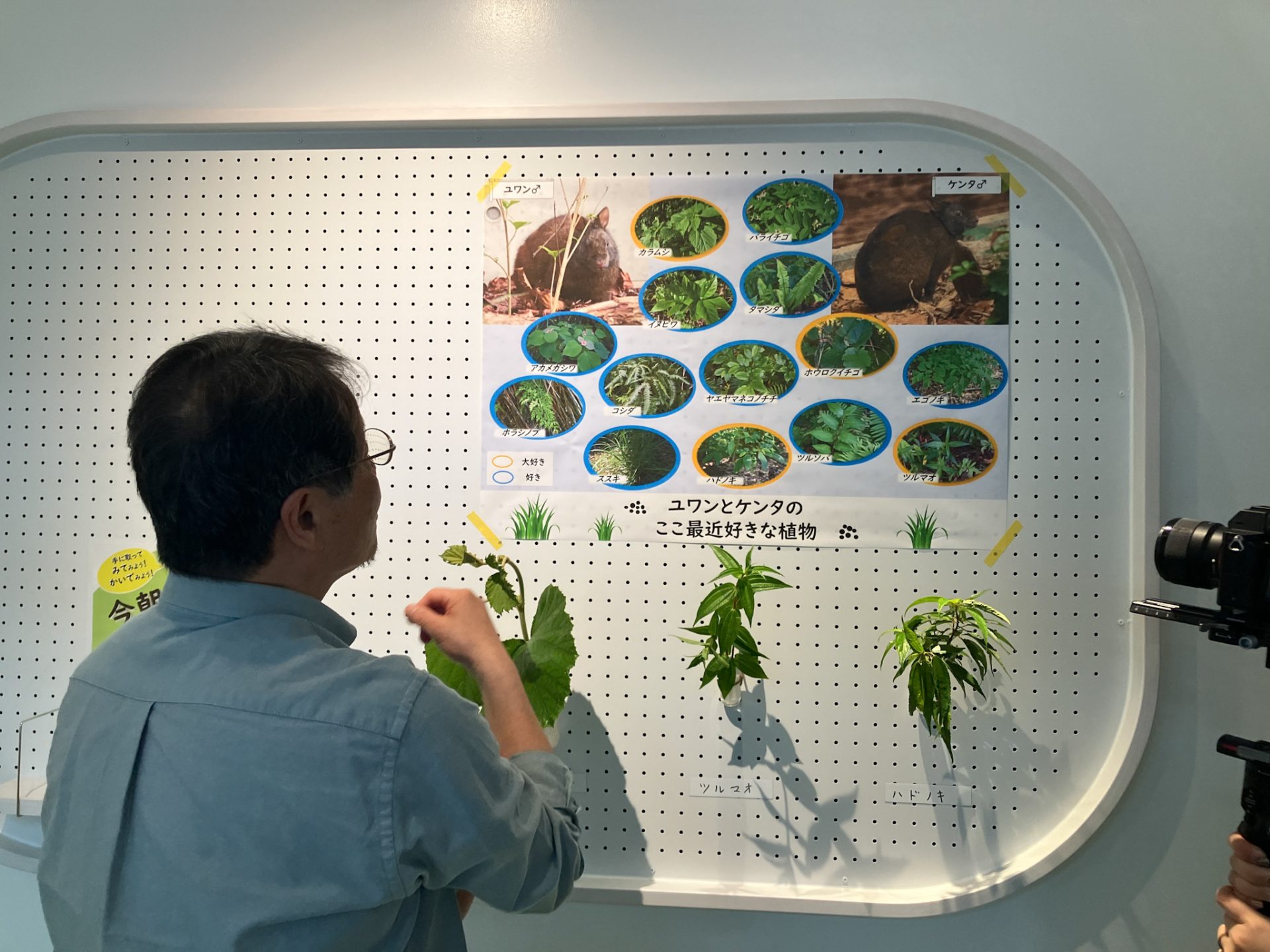 Introducing the vegetation that Ewan and Kenta, who are rescued and kept at Quru Guru, like to grow.
The plants on display are collected daily from the mountains by staff, and are part of what the Japanese black rabbits actually eat that day, creating a realistic and fresh display.
Shimokuni:
Raising and observing the rescued individuals at Quru Guru may lead to further research into the Japanese black rabbit itself and the discovery of the island's unique ecosystem.
Please tell us what role you would like Quru Guru to play and what kind of place you would like it to be.
Professor Yamada:
Quru Guru is a village-run facility managed by Yamato Village, a small village with a population of about 1,400.
Although the museum has just opened, we have a responsibility to ensure that it continues to function.
To that end, I would like to make this a facility that is loved, understood, and trusted by the villagers.
They have also succeeded in eradicating mongooses (introduced by humans), which had a major impact on Amami Oshima, and the number of Japanese black rabbits has recovered. However, there has also been an increase in roadkill, which is a direct human impact, and Japanese black rabbits have been gnawing at the tangerine trees and sugarcane cultivated by people. This has caused frustration for farmers, so the village and the entire island are working to prevent and reduce damage.
In order to carry out such efforts, we hope that the islanders will be able to observe the rabbits in captivity, learn about their ecology, and use this as an opportunity to consider countermeasures.
Shimokuni:
We aim to create a facility that not only allows us to observe the black rabbit and other rare Amami creatures, but also allows the villagers of Yamato Village, the islanders, and everyone involved with Amami who live alongside the black rabbit, to concretely explore how they can coexist in the future.
I had the opportunity to visit Amami to create the Quru Guru exhibition, and there were many moments when I thought, "What a wonderful island!"
On the night tour, we were taken in a car and entered the forest at night. The smell of earth and the smell of greenery changed depending on the location, waking up all five senses. As the various stimuli permeated my entire body, I felt like I was relieving my fatigue, and it had an excellent detoxifying effect.
When I came to Amami, my eyesight suddenly improved...or perhaps my senses became more sensitive, and I was able to instantly spot insects, birds, and small animals in the dark, which was an interesting sensation.
As we walked around the forest on the night tour, we could see the changes that have taken place as Yamato Village has updated its efforts to coexist with the black-crowned bunny. When I came here four years ago, the road was just an ordinary one, but the next time I went there, there were signs saying "Watch out for black-crowned bunnies," fences had been erected to prevent the bunnies from being run over, and netting had been put up that was too big for the bunnies to get through. I saw signs of improvements being made in various places.
While Quru Guru will continue to send messages to each individual visitor, I believe that the "social initiatives" being undertaken by the village and island as a whole will continue to increase.
Professor Yamada:
Rabbits are herbivores, so if they are properly protected, they will increase in number in line with their habitat. When mongooses were plentiful, black rabbits were on the verge of extinction, but they are now recovering. However, as their numbers increase, problems arise.
It is up to us humans to take conservation and measures to ensure coexistence and symbiosis.
On the other hand, there are also benefits to be gained from the presence of the Japanese black rabbit, a "living fossil" and "Japan's first natural monument." Some people come to visit because they love the Japanese black rabbit and think it's so cute, while others come to understand the island and become fans. As a result, I believe that the number of people who want to live on the island or be involved in some way will continue to increase.
The black rabbit was the catalyst, and it's something that happens on this island, which is so fascinating with its rich forests, sea, and nature.
We hope that this facility will provide an opportunity to think about the ecosystem and history of the entire island, including the animals, nature, and people, through the black rabbit. We would also be delighted if people both on and off the island, and around the world, could learn about the efforts of this facility and understand that this island is striving for animals and people to coexist in harmony.
Shimokuni:
Thank you for today, Professor Yamada.
The "coexistence between nature and humans" is not just an issue for Amami Oshima, but is a future challenge for Japan and anywhere in the world where the impacts of environmental change and human activity are becoming more serious.
We also received suggestions on how to create an exhibition facility that deals with life, which gave us time to think again about how to communicate and present the information.
I'm looking forward to seeing what Quru Guru does next!
[Video of a conversation with Professor Yamada]
The conversation with the professor has also been compiled into a video of him walking around the facility, so please take a look.
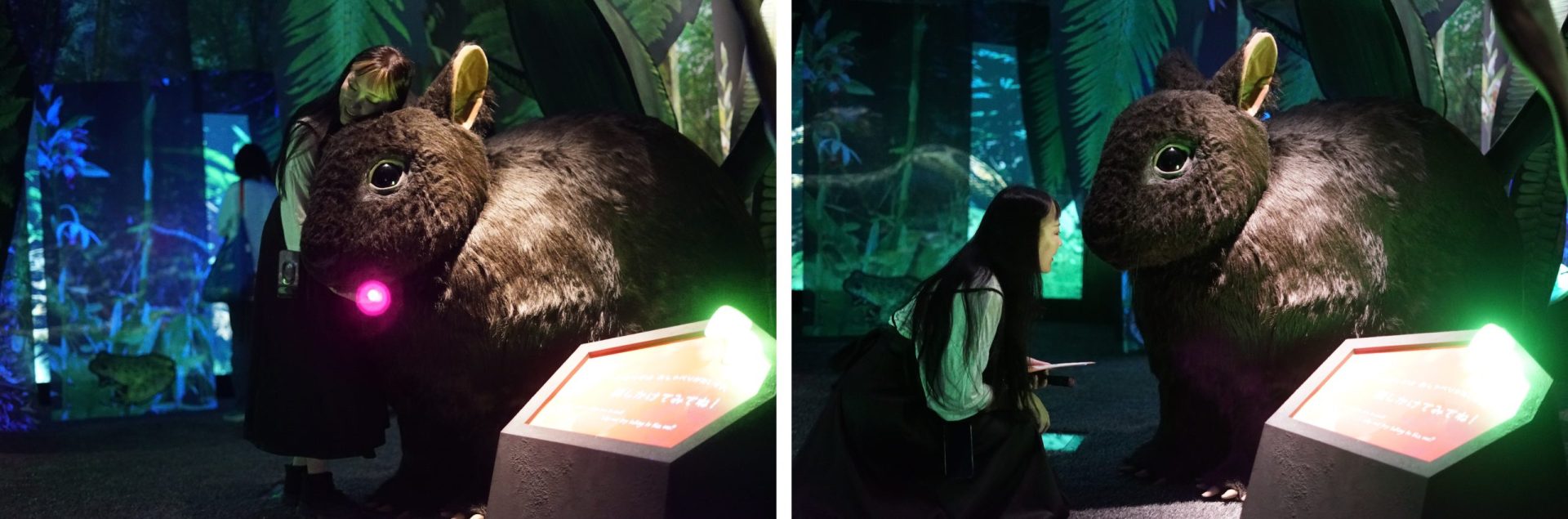 In "Kuruguru Forest," visitors experience the night forest from the perspective of a black rabbit. Therefore, the creatures they encounter here greet visitors at approximately four times their actual size.
I hope we can find a future where we can coexist with these adorable creatures while maintaining an appropriate distance.
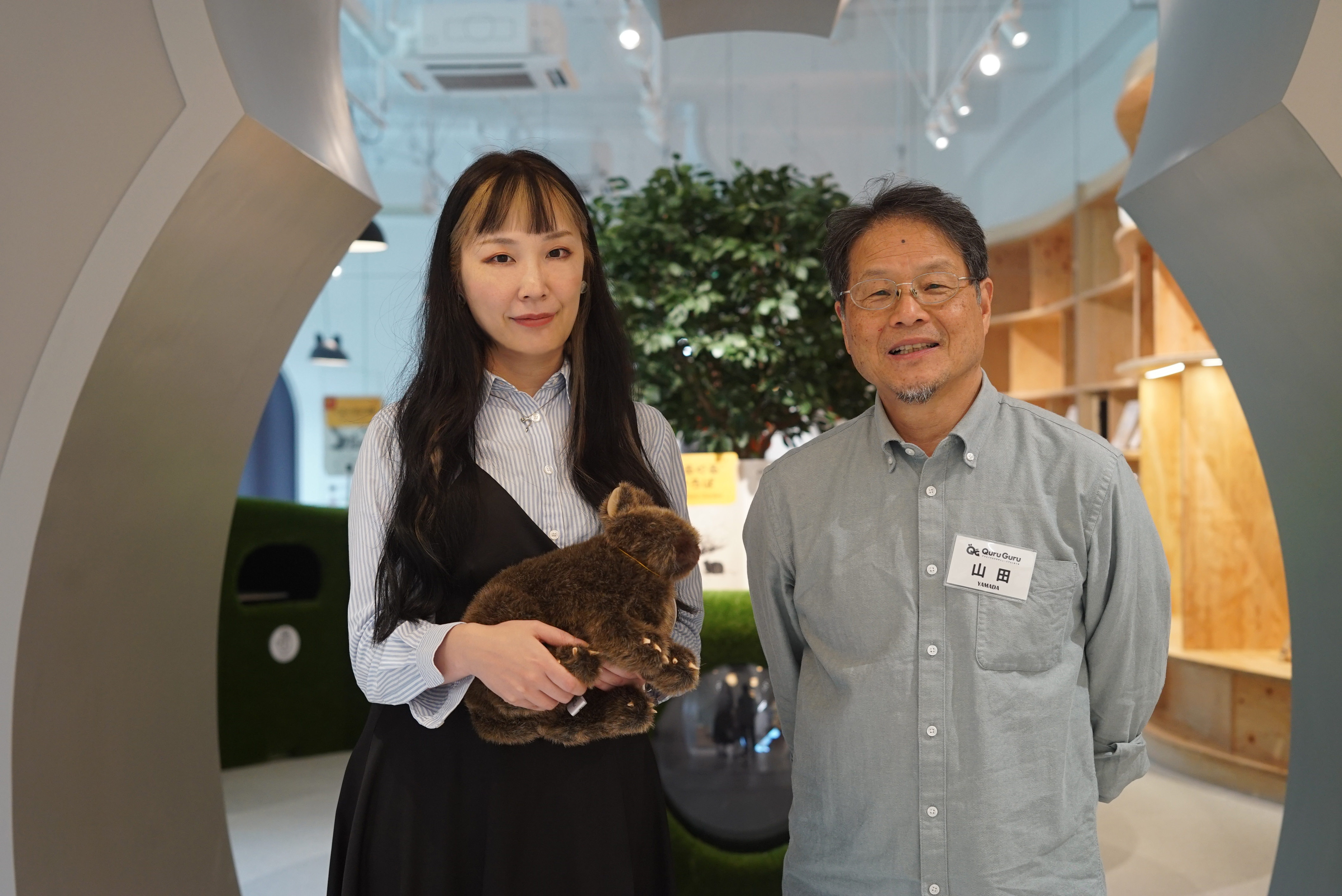
Location: Amami Rabbit Museum Quru Guru
Like this article?
- editor
-

-
Glo-cal planner
We will plan globally and locally from the public building to the product☆